
The best speakers for a record player are the last thing in the chain and the first thing you actually hear. You can spend $400 on a turntable and $150 on a cartridge and run both through a $60 speaker pair that compresses the midrange and rolls off the top end. The result sounds like a $60 system. Six record player speakers ranked across two categories, powered and passive, because the type you need depends on your setup, not your budget. If you are still building the rest of the chain, the best turntables of 2026 guide covers every deck worth buying.
Quick Picks
| Pick | Product | Type | Price |
|---|---|---|---|
| Best Powered Budget | Edifier R1280DB | Powered | ~$160 |
| Best Powered Deal | Klipsch R-51PM | Powered | $349.99 (deal) |
| Best Powered Premium | Klipsch R-40PM | Powered | $423.26 |
| Best Passive Overall | Q Acoustics 3020i | Passive | $479 |
| Best Passive Value | Klipsch RP-600M | Passive | $349 (sale) |
| Best Budget Passive | Polk Audio T15 | Passive | $149 |
All Six Speakers at a Glance
Every speaker side by side. Prices verified April 2026.
Powered · 42W RMS
Phono preamp
Built-in
Bluetooth
Yes
Optical
Yes
Price
~$160
Powered · 60W/ch
Phono preamp
Built-in
Bluetooth
Yes
Optical
Yes + USB
Price
$349.99 (deal from $499.99)

Powered · 240W peak
Phono preamp
Built-in
Bluetooth
Yes
Optical
Yes + USB + RCA
Price
$423.26 (from $549)
Passive · 6Ω
Phono preamp
Amp required
Bluetooth
No
Sensitivity
88dB
Price
$479
Passive · 8Ω
Phono preamp
Amp required
Bluetooth
No
Sensitivity
96dB
Price
$349 (from $549)
Passive · 8Ω
Phono preamp
Amp required
Bluetooth
No
Sensitivity
89dB
Price
$149
Powered or Passive: The Decision You Make First
Every speaker for a turntable falls into one of two categories. Getting this decision wrong means buying the wrong product entirely, so sort it out before looking at any specific model.
Powered speakers have a built-in amplifier. You run a cable from your turntable’s output into the back of the speaker and that is the whole setup. No receiver, no separate amp box, no second set of cables. The Edifier R1280DB, Klipsch R-51PM, and Klipsch R-40PM all have built-in phono preamps, which means any turntable connects directly with nothing else required. For someone who wants to plug in and play records, powered speakers are the correct answer. The honest tradeoff: at the same total budget, a separate amplifier and passive speaker pair usually produces noticeably better sound above $400. Below it, powered wins on both value and simplicity.
Passive speakers have no amplifier. They require a separate stereo integrated amplifier or receiver between the phono preamp and the speakers. More boxes, more cables, more money upfront. What you get in return is better sound per dollar at any combined budget above $400. A dedicated amplifier circuit in a standalone unit is better engineered than the same circuit crammed into the back of a speaker cabinet. If you already own an amplifier or receiver, passive speakers are always the right choice. The Yamaha A-S301 (~$350) or Denon PMA-600NE (~$300) pair well with every passive speaker in this guide. For more on the preamp side of the chain, the best phono preamps of 2026 guide covers what sits between the turntable and the amp.
The Best Powered Speakers for a Record Player
Three powered options covering the full range from budget to premium. All three have built-in phono preamps and connect directly to any turntable.
Best Powered Budget
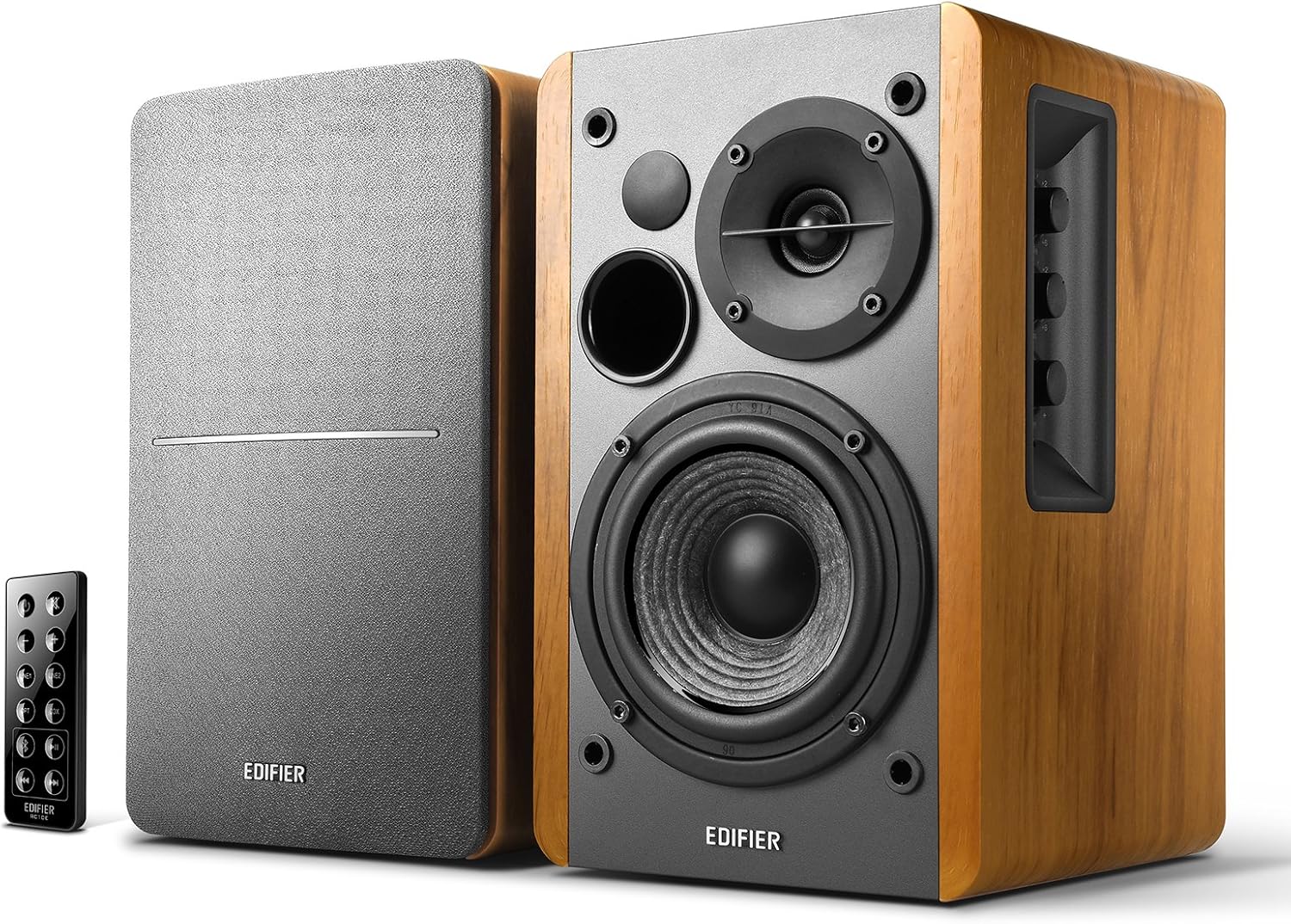
Edifier R1280DB Powered Bookshelf Speakers
The default recommendation for anyone who wants powered speakers for a turntable and does not want to think about it. Two RCA inputs on the back, one with a built-in phono preamp and one standard line level, mean you can connect a turntable directly without buying anything else and still leave the second input free for a phone or a TV. Bluetooth covers wireless streaming. Optical covers anything with a digital output. At around $160 with 4,791 Amazon reviews at 4.6 stars, you run out of reasons to look elsewhere before you run out of inputs. The sound is honest and competent. Good enough to start with, and a natural upgrade point once the system matures.
Best Powered Deal

Klipsch R-51PM Powered Bookshelf Speakers
At $349.99 on a limited time deal from $499.99, the Klipsch R-51PM is exceptional value for a powered speaker with genuine Tractrix horn technology. Klipsch brought the Tractrix horn tweeter from its passive Reference Premiere line into this powered design, and the difference is audible from the first track. The horn disperses high frequencies more evenly across the room than a standard dome tweeter. On a well-pressed jazz or folk record the soundstage opens up noticeably at this price point. At the current deal price, this sits at the same cost as the Klipsch RP-600M passive speakers alone, before adding an amplifier.
The character to know before buying: the Tractrix horn is direct and detailed. It rewards well-recorded vinyl. On aggressively mastered pop or compressed modern recordings it reveals every flaw in the production. If the deal price has expired when you check, the Klipsch R-40PM below is the reliable premium powered alternative.
Best Powered Premium

Klipsch Reference R-40PM Powered Bookshelf Speakers
The Klipsch R-40PM is the reliable premium powered choice when the R-51PM deal price is unavailable. Sold directly by Amazon.com at $423.26 from $549, it is the most versatile powered speaker on this list: Bluetooth, built-in phono preamp, optical, analog RCA, USB, and a subwoofer output for future expansion. The 90-degree Tractrix horn is updated from the Reference Premiere line for wider dispersion. The sweet spot is broader than a standard dome tweeter design, which matters in a living room where you are not always sitting in a fixed position.
With 240W peak power through spun-copper polymer woofers, bass extends to 60Hz without a subwoofer. Most bookshelf speakers at this price require one to reach similar low-end weight. At $423 direct from Amazon with the Overall Pick badge, 172 reviews at 4.5 stars, and In Stock status as of April 2026, this is the consistent premium powered choice without deal timing risk.
The Best Passive Speakers for a Record Player
Adding an amplifier to the setup is worth the extra step. At the same total budget, passive speakers plus a dedicated integrated amplifier consistently outperform powered speakers. Three passive options worth buying, ranked by editorial score.
Best Passive Overall
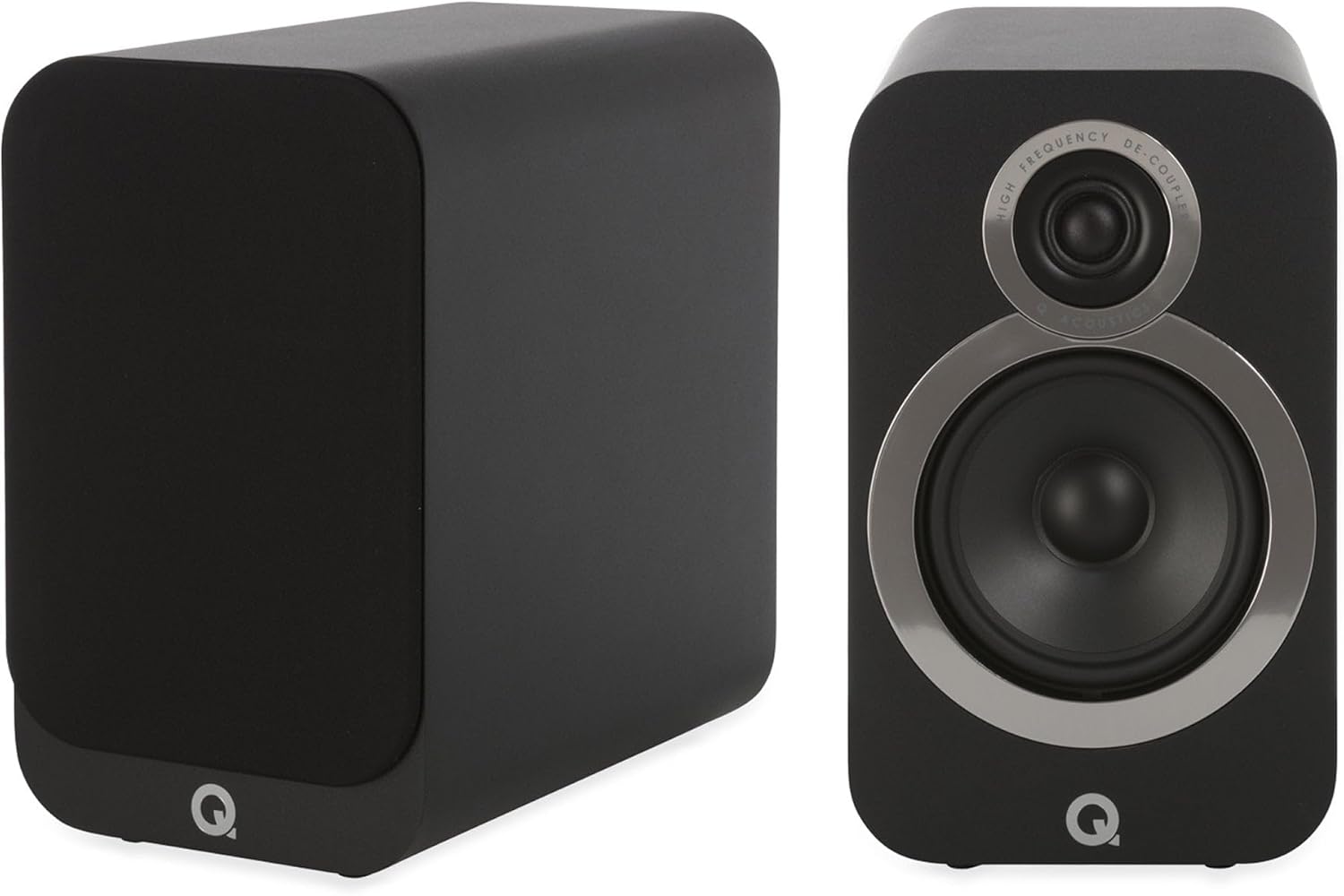
Q Acoustics 3020i Bookshelf Speakers
The 3020i is the speaker that changes what people expect from their system. Most listeners who hear it for the first time are surprised by the size of the image it produces, with instruments occupying specific positions across the room rather than sound coming from two boxes on a shelf. Q Acoustics built the 3020i with a cabinet 25% larger than its predecessor and internal P2P bracing that keeps the enclosure rigid under load. A quiet cabinet means the drivers reproduce the recording rather than the box resonating around it. Consistently recommended by major publications including What Hi-Fi? and Wirecutter across multiple years of testing.
Pair with the Yamaha A-S301 (~$350) or Denon PMA-600NE (~$300). Total setup sits between $779 and $829. That is a serious investment, but the result outperforms powered speakers at that budget clearly enough to justify the difference. To round out the chain, the best turntable cartridges of 2026 covers the other end of the signal path.
Best Passive Value Right Now

Klipsch RP-600M Reference Premiere Bookshelf Speakers
Sensitivity matters more with a turntable source than most people realise. At 96dB the RP-600M is extraordinarily efficient. The amplifier runs well within its limits at normal listening volume, which is where amplifiers sound best. At $349 on sale from $549, paired with a $300 Denon PMA-600NE, this is currently the most compelling passive setup on the list at $649 total. 1,247 reviews at 4.8 stars, Amazon’s Choice, In Stock, sold by Crutchfield. The character to know: the Tractrix horn rewards well-recorded classical, jazz, folk, and acoustic music. On aggressively mastered modern recordings it tells you every flaw.
Best Budget Passive

Polk Audio T15 Bookshelf Speakers
The T15 is not exciting. It is practical. A $149 passive speaker paired with a $150 stereo receiver produces a better-sounding result than a $149 powered speaker, because the amplifier section in a dedicated receiver is better engineered than the plate amplifier inside a budget powered speaker cabinet. The difference is audible in bass control and midrange clarity. Front-firing port means it can sit flush against a wall. MDF cabinet, not hollow plastic. 7,335 reviews at 4.7 stars, sold directly by Amazon.com. The upgrade path is straightforward: when the T15 becomes the limiting factor, replace the speakers and keep the receiver.
How Far Should Speakers Be From Your Turntable
Closer than they should be. That is the situation in most setups and it creates a problem nobody talks about enough. Speakers produce vibrations. When the speakers and the turntable share the same surface, those vibrations travel through the structure to the turntable’s platter and tonearm. The stylus reads them as signal and plays them back. The result is muddier bass and a loss of low-level detail that degrades the sound without ever announcing itself as a problem.
The correct solution is separate furniture. Turntable on its own stand, speakers on stands or a different surface. Where that is not practical, isolation feet under the turntable absorb the vibration path. Keep at least 12 inches between the nearest speaker cabinet and the edge of the platter. The improvement when you get this right is not subtle.
How to Connect Speakers to a Record Player
Four steps. The only one that catches people out is the first.
- Check for a built-in preamp. Look for a PHONO/LINE switch on the back of your turntable. If it is there, set it to LINE before connecting to anything. If there is no switch, your turntable has no built-in preamp and you need an external one. Our best phono preamps guide covers every option from $65.
- For powered speakers: run an RCA cable from the LINE output of your turntable into the RCA inputs on the powered speaker. If the speaker has a built-in phono stage (the Edifier R1280DB, Klipsch R-51PM, and R-40PM all do), connect the turntable directly to that input with the PHONO/LINE switch set to PHONO.
- For passive speakers: run RCA cables from the phono preamp output into the AUX or CD input on your amplifier or receiver. Connect the amplifier to the speakers with standard 16-gauge speaker wire. That handles any room under 30 feet.
- Start with volume at zero. Power on everything. Raise volume slowly.
What to Look For in Turntable Speakers
Sensitivity is the spec most people ignore and should not. A speaker rated at 88dB needs twice the amplifier power to match the volume of a speaker rated at 91dB. At 96dB the Klipsch RP-600M is extraordinarily efficient. The amplifier runs well within its limits at normal listening volume, which is exactly where amplifiers sound best. Impedance is the other number that matters: 8 ohm nominal is safe for any amplifier. Six ohm (the Q Acoustics 3020i) is fine for any modern integrated amplifier. Four ohm speakers require a more powerful amp and are best avoided for a first passive setup.
For powered speakers the key question is whether the built-in phono stage is switchable between PHONO and LINE. All three powered speakers on this list have switchable phono stages. A dedicated external phono preamp will extract meaningfully more from a good cartridge than any built-in stage. The best vinyl record cleaning kits guide is a reminder that the source also deserves attention before the signal reaches the speakers.
Frequently Asked Questions
Yes, if your turntable has a built-in phono preamp. Look for a PHONO/LINE switch on the back, set to LINE. The Edifier R1280DB, Klipsch R-51PM, and Klipsch R-40PM all have built-in phono stages, meaning a turntable without a built-in preamp can connect directly. Without a phono preamp somewhere in the chain, the result is very quiet, very thin sound with almost no bass.
No. Powered speakers have a built-in amplifier and connect directly from a phono preamp or turntable line output. A receiver is only required for passive speakers, which have no built-in amplification.
As far as possible. Speaker vibrations travel through furniture to the turntable platter and stylus, creating feedback that degrades sound quality. Separate furniture for the turntable and speakers eliminates the problem. Where that is not possible, use isolation feet under the turntable and keep at least 12 inches between the nearest speaker cabinet and the turntable platter.
Active (powered) speakers have a built-in amplifier and connect directly from a phono preamp. Passive speakers require a separate integrated amplifier or receiver. Passive speakers produce better sound per dollar at total budgets above $400 but require more equipment. Powered speakers are simpler and cost less upfront.
For the Q Acoustics 3020i and Klipsch RP-600M, the Yamaha A-S301 (~$350) or Denon PMA-600NE (~$300) are the standard recommendations. Both are dedicated stereo integrated amplifiers. Avoid mid-priced AV receivers at the same price. The amplifier section in a dedicated stereo integrated amp outperforms the equivalent section in a feature-laden AV receiver.
Yes. Studio monitors are powered speakers designed for flat, accurate frequency response. They connect to a turntable via a phono preamp and work well for listeners who want accuracy over warmth. The response is honest about the recording rather than flattering.
James Calloway has been collecting vinyl for 22 years. He spent six years working at an independent record store in Chicago where he evaluated and set up systems across every budget. He writes all gear guides and record reviews for VinylPickup.com.


