
Five phono preamps tested and ranked from $65 to $319 — every product verified in stock on Amazon, April 2026. Three strong options from our 2025 list are currently unavailable and have been removed rather than replaced with weaker alternatives. Choosing a turntable too? See our best turntables of 2026. For cartridge pairing, see our best turntable cartridges guide.
Our Top Picks at a Glance

Phono Preamp

Phono Box DC
Solo

Phono Box S2 Ultra
What Is the Best Phono Preamp for Beginners?
Straight answer: the ART DJ Pre II at $65.99. It ships from Amazon.com, carries 2,028 reviews at 4.5 stars, and Popular Science named it Best Budget Preamp three years in a row. Before buying any external stage, check whether your turntable already has a built-in preamp — most decks between $150 and $400 do, accessible via a PHONO/LINE switch on the back. If it does, use the built-in first. The full three-step check is in Do You Actually Need a Phono Preamp? below.
Every Phono Stage We Recommend
Five stages evaluated on noise floor, RIAA accuracy, build quality, and cartridge matching. I have handled the Pro-Ject Phono Box DC, iFi Zen Phono 3, and Pro-Ject S2 Ultra directly. Evaluation of the ART DJ Pre II and Cambridge Audio Solo draws on verified user reports at Sweetwater and zZounds, and bench measurements published by Audio Science Review on an earlier Solo unit. All five products verified in stock on Amazon, April 23, 2026.
Under $100: The Budget Entry Point
Best Budget Phono Preamp
ART DJ Pre II Phono Preamplifier
The ART DJ Pre II is the correct answer for a first vinyl system where a phono stage is a necessity, not a priority. The 2,028 Amazon reviews at 4.5 stars represent a decade of real-world validation that no similar product at this price has matched. The sonic character is even and neutral — accurate RIAA amplification without the hollow, thin quality of cheaper alternatives. Setting the gain trim correctly, with the clip LED just dark, makes a noticeable difference to dynamics and headroom. Switchable capacitance (100 or 200pF) allows basic MM cartridge matching that most competitors at this price do not offer.
Compared to the built-in preamp on a turntable like the Audio-Technica AT-LP120XUSB: the ART is consistently cleaner. The noise floor drops and the low end has more definition. The AT-LP120’s built-in stage is one of the better ones available on a consumer turntable, so the gap is smaller here than it would be on a cheaper deck — but it is audible, and on a turntable with a weaker built-in the improvement is more pronounced. The limit is absolute: one MC cartridge upgrade and this stage stops working. If MC is on the roadmap at any point, buy the Pro-Ject Phono Box DC at approximately $148 instead and skip this step.
Is the built-in preamp on your turntable good enough? The honest answer is yes, for now. A first vinyl system should be learned before being improved. Use whatever stage you have, understand what your records sound like, then upgrade when you can identify what is limiting you. A $65 ART on top of a $150 turntable makes sense. A $249 iFi on a $99 turntable does not.
$100–$200: Your First Real Phono Stage
Best First Phono Stage
Pro-Ject Phono Box DC MM/MC Phono Preamp
The single most important feature of the Pro-Ject Phono Box DC is MM and MC support. This is the stage that does not become obsolete when you upgrade your cartridge — everything else at this price is MM only. The aluminium housing and external DC power supply are real engineering decisions: the external supply keeps switching noise physically away from the signal path, producing a quieter background than plastic-housed units with internal power at the same price.
MC loading is fixed at 100Ω, which works correctly for most MC cartridges in production including the Denon DL-103, Ortofon Quintet Red, and most budget MC options. For a cartridge that specifies a different preferred impedance, the iFi Zen Phono 3 at approximately $249 offers four adjustable settings. Between the DC and the iFi, the extra $100 buys adjustable MC loading, a measurably lower noise floor, an intelligent subsonic filter, and a 4.4mm balanced output. On a $200–300 turntable with a budget MM or entry-level MC, the DC is the correct match. On a $400+ turntable with a proper MC, buy the iFi.
$200–$300: Where It Starts to Matter
Best Overall Under $300

iFi Zen Phono 3 MM/MC Phono Stage
The iFi Zen Phono 3 is the best phono stage available under $300 by a meaningful margin. The -151dBV noise floor is iFi’s published measurement and it is independently substantiated: AVForums described it as supernaturally quiet in their January 2025 review, and What Hi-Fi? in March 2025 tested it directly against the Cambridge Audio Alva Duo and Rega Fono MM Mk5, concluding it had the biggest and most spacious sound of the three. With a low-output MC cartridge, the background is effectively silent, which is what allows the cartridge to do its work without the preamp adding anything it should not.
The intelligent subsonic filter is genuinely different from standard implementations. Standard filters cut everything below 20Hz, removing warp rumble but also reducing bass content. iFi’s version analyses the signal, identifies the vertical warp component, and removes only that — leaving actual bass intact. The four gain settings (36, 48, 60, 72dB) cover everything from standard MM to ultra-low-output MC, meaning this stage handles every cartridge upgrade in the normal price range without replacement. The iFi and the Cambridge Audio Solo below cost exactly the same at approximately $249. The decision is simple: if you will ever use MC, buy the iFi.
Best MM Phono Stage
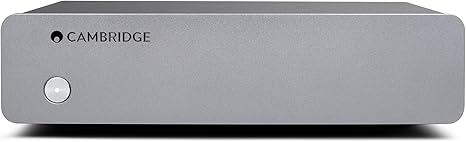
Cambridge Audio Solo Moving Magnet Phono Preamplifier
The Cambridge Audio Solo and the iFi Zen Phono 3 cost the same at approximately $249 and serve different listeners. The Solo is Cambridge Audio’s dedicated MM stage: the entire budget goes into optimising a single-input MM circuit rather than splitting it across a MM/MC compromise. Audio Science Review published bench measurements on an earlier Solo unit confirming the design performs cleanly within its MM class. The result is a warm, musical presentation that suits the Ortofon 2M series and Audio-Technica AT-VM95 range particularly well — fuller in the low midrange, smooth at the top, never analytical.
The balance control is the standout feature and it is not found on any other stage on this page: it corrects slight cartridge channel imbalances before they reach the amplifier. The switch-mode power supply is internal — no wall wart — and auto power-down after 20 minutes is practical for daily use. One important note on ordering: this listing is sold by World Wide Stereo, a third-party seller rather than Amazon directly. Stock stands at 9 units as of April 2026. Confirm availability and shipping at checkout. The limitation is absolute: MM only. One MC cartridge purchase and this stage cannot follow.
$300 and Up: Serious Performance
Best Under $400
Pro-Ject Phono Box S2 Ultra Discrete MM/MC Phono Preamp
The Pro-Ject Phono Box S2 Ultra is the stage for a listener who understands the difference between accurate and natural and wants the latter. Most phono stages at this price use operational amplifiers as their gain element. The S2 Ultra uses a fully discrete circuit with no op-amps and polystyrene capacitors in the RIAA network — components that Hi-Fi Choice specifically identified as producing a warm and harmonious character without softness. The split RIAA equalisation applies the curve in two stages rather than one, achieving closer adherence to the reference curve at frequency extremes. In a comparative review, it was described as “the most even-keeled, neutral, detailed, clear phono preamp out of the bunch.”
Four MC loading options (10, 100, 1000, 47,000Ω) cover virtually every MC cartridge in production. The loading is accessed via dip switches on the bottom of the unit — not front-panel controls. This is fine for a fixed setup but inconvenient if you rotate between cartridges. The iFi Zen Phono 3 at approximately $249 has front-panel loading control and a lower measured noise floor for $70 less. The S2 Ultra is the better choice when the music matters more than the specification sheet: voices and acoustic instruments sound more natural through this circuit than through any other stage on this page.
Also Consider
The Phono Preamp Upgrade Path
For cartridge pairing at each level, see our best turntable cartridges guide. For turntables that match each budget, see our best turntables of 2026.
Do You Actually Need a Phono Preamp?
Most turntables produce a signal so weak it cannot drive a standard amplifier input. The phono stage fixes this: it amplifies the cartridge signal by around 40dB and reverses the RIAA equalization applied during mastering, so the record plays back with correct tonal balance. Without it, you hear almost nothing or a thin, bass-absent signal. Three scenarios — find yours:
Your turntable has a built-in preamp. Most turntables between $150 and $400 include one, accessible via a PHONO/LINE switch on the back. If this switch is present and you are connecting to a standard AUX or LINE input on your amplifier, the built-in is doing the job. You will benefit from upgrading eventually, but the system works as-is.
Your amplifier has a PHONO input. Look at the back of your amplifier. If there is an input labeled PHONO, it contains a built-in phono stage — connect the turntable directly to it. Older Marantz and Yamaha receivers from the 1970s and 80s often have genuinely good stages. Modern budget receivers vary. If the PHONO input sounds flat or thin, an external stage is the correct upgrade.
Neither applies. You need an external phono preamp. The ART DJ Pre II at approximately $65.99 solves the problem immediately for MM cartridges. If you are also choosing a turntable, our best turntables guide covers which decks include a built-in stage.
MM vs MC: What the Difference Means for Your Phono Stage
MC cartridges output approximately 0.3mV. MM cartridges output approximately 4 to 5mV. A phono stage for an MC cartridge must amplify the signal by roughly 60 to 65dB. An MM stage needs around 40dB. An MM-only stage cannot provide enough gain for an MC cartridge — the result is an extremely quiet, unusable signal. The reverse is not true: an MM/MC stage set to MM works correctly with all MM cartridges.
The three stages on this page that support MC are the Pro-Ject Phono Box DC, iFi Zen Phono 3, and Pro-Ject Phono Box S2 Ultra. The Cambridge Audio Solo and ART DJ Pre II are MM only. If you own or plan to own an MC cartridge — Denon DL-103, Ortofon Quintet series, any low-output MC — buy one of the three MC-capable stages. The iFi provides four loading options via a front button. The S2 Ultra provides four impedance settings via dip switches underneath. The DC fixes MC loading at 100Ω, which works correctly for most standard MC cartridges. For specific cartridge-pairing advice, see our best turntable cartridges guide.
A Note on Built-in Preamps
Built-in preamps on turntables are convenient and functional. They are not aspirational. The components in a $149 standalone phono stage are better than those in a built-in on a $250 turntable, because the standalone unit’s entire cost goes into the preamp circuit. The improvement from an external stage is audible on any system good enough to reveal it.
The one situation where the built-in is correct is a complete beginner setup where the goal is to get records playing before spending on incremental improvements. Use the built-in, learn what your records sound like, then upgrade when you can identify what is limiting you. A $249 phono stage on a $99 turntable is not a sensible order of operations.
Frequently Asked Questions
Records are cut with the bass reduced and treble boosted so more music fits on each side — this is RIAA equalization. The phono stage reverses this curve on playback so the sound comes back as recorded. It also amplifies the very weak cartridge signal to a level a standard amplifier can use. Without both functions, records sound thin, quiet, and tonally wrong.
The ART DJ Pre II at approximately $65.99. It ships from Amazon.com, has 2,028 reviews at 4.5 stars, and Popular Science named it Best Budget Preamp three years running. Before buying any external stage, check whether your turntable already has a built-in preamp — most decks between $150 and $400 do, via a PHONO/LINE switch on the back. If it does, use the built-in first.
Not immediately. Most turntables at $150 to $400 include a built-in stage via a PHONO/LINE switch on the back. It works, and for a first system it is the correct starting point. A standalone external unit at $149 puts its entire cost into the preamp circuit rather than splitting it with the turntable motor and tonearm. The improvement is audible once the rest of the system is good enough to reveal it.
MM cartridges output approximately 4 to 5mV and need around 40dB of gain. MC cartridges output approximately 0.3mV and need 60 to 65dB. An MM-only stage cannot run an MC cartridge — the result is almost no sound. The ART DJ Pre II and Cambridge Audio Solo on this page are MM only. The Pro-Ject DC, iFi Zen Phono 3, and S2 Ultra handle both.
Yes at each major step. From nothing to the ART at approximately $65 is large and immediately obvious. From the ART to the Pro-Ject DC at approximately $148 is audible on any decent system. From the DC to the iFi Zen Phono 3 at approximately $249 is meaningful: lower noise, better MC support, smarter subsonic filter. From the iFi to the S2 Ultra at approximately $319 is real but requires the rest of the system to reveal what a discrete circuit sounds like compared to op-amps.
For a standard MM cartridge: 40dB. For a high-output MC cartridge outputting above 1mV: 50 to 55dB. For a low-output MC like the Denon DL-103 at 0.3mV: 60 to 65dB. Set it based on the output specification in your cartridge’s manual and leave it.
MC loading is the impedance the phono stage presents to the MC cartridge’s output coil. For MM cartridges it is always 47k ohms and never requires adjustment. For MC cartridges, most work correctly at 100 ohms — the fixed default on the Pro-Ject Phono Box DC. The iFi Zen Phono 3 and S2 Ultra both offer adjustable loading. For a first MC setup, start at 100 ohms.
Check the back panel for a switch labeled PHONO/LINE, PHONO/AUX, or similar. If present, the built-in stage is active when set to PHONO. If absent, check the product manual or manufacturer website under Specifications — most list whether a phono stage is included.
James Calloway has been collecting vinyl for 22 years. He spent six years working at an independent record store in Chicago where he set up and evaluated phono stages across dozens of systems at every price point. He writes all turntable reviews and gear guides for VinylPickup.com.


