

Audio-Technica AT-LP120XUSB Review 2026: The Most Complete Turntable Under $400
Direct drive, built-in preamp, USB output, 78 RPM, and an upgradeable AT-VM95E cartridge. Nothing else under $400 does all of that.

AT-LP120XUSB Review 2026
Quick Verdict

Audio-Technica AT-LP120XUSB Direct Drive Turntable
Most people searching for the AT-LP120XUSB review are trying to answer one question: is this the right first serious turntable, or is there something better for the money? After six years behind the counter of a Chicago record store and 22 years of collecting, my answer is yes for most people, with one clear qualification. The Audio-Technica AT-LP120XUSB at ~$399 is the most complete deck at this price. Direct drive, built-in switchable preamp, USB digitizing, 78 RPM capability, and an upgradeable AT-VM95E cartridge in one box. Nothing else matches this feature set under $400.
I put on The Clash London Calling the first time I set this deck up and it delivered a genuinely satisfying listen. Strummer’s vocals sat forward, the bass guitar had warmth and weight. The main weakness is not sound but build: it is lighter than the original LP120, and the bass is warm rather than tight. The U-Turn Orbit Plus at the same $399 has better build solidity and more neutral sound, but requires a separate phono preamp and has no USB output. If you want everything in one box, buy this.
Specs
Pros and Cons
Design and Build
The first thing you notice when the AT-LP120XUSB comes out of the box is the Technics SL-1200 resemblance. Same general layout: the S-shaped tonearm to the right, the strobe and pitch slider on the left, the start/stop button at the front. Audio-Technica designed the LP120 series as a DJ-friendly direct drive alternative and the form factor reflects that heritage. What is different from the original is immediately apparent when you pick it up. The LP120XUSB weighs 5.0 kg. The original LP120 weighed considerably more. The current model feels light at the base, particularly on the left side where the motor sits. Pick up a U-Turn Orbit Plus at $399 and you feel the difference in plinth density immediately.
The platter is die-cast aluminum, a genuine step up from the stamped steel platters on cheaper decks. It spins with no wobble. The included felt mat is adequate to start but worth replacing with a cork or acrylic mat once you are settled in. The four rubber isolation feet do their job at typical listening volumes. Controls are clearly labeled and large enough to find in the dark, with the stylus target light illuminating the groove when you need to cue in low light.
The tonearm and headshell punch furthest above their price. The AT-HS6 headshell is a universal half-inch mount unit that accepts any standard cartridge. Most decks at this price have fixed headshells. The fact that you can swap the entire headshell in thirty seconds makes cartridge upgrading genuinely easy, and is one real advantage over the U-Turn Orbit Plus, which has better overall build solidity but a more restricted upgrade path.
Setup
In the box: USB cable, detachable RCA output cable, AC adapter, 45 RPM adapter, counterweight, felt mat, and removable hinged dust cover. Everything you need to play records is included. If you have set up a tonearm before, you will be playing records in under ten minutes. If this is your first time, budget twenty to thirty minutes and follow the manual carefully.
The critical step is counterweight balancing, and this is where first-timers go wrong. Before you set tracking force, balance the tonearm to zero: hold the tonearm level and rotate the counterweight until the arm floats parallel to the platter with no tendency to rise or fall. Only then turn the numbered tracking force dial to 2, setting 2 grams of downforce. Anti-skate is the small dial at the base of the tonearm. Set it to match your tracking force.
If you are ready to add an external phono stage, the best phono preamps guide covers every option from $149 to $799. The Pro-Ject Phono Box DC at $149 is the natural first pairing for this deck: MM and MC support, clean noise floor, and nothing unnecessary. Set the deck to LINE, connect the RCA cables to the preamp, and the improvement over the built-in stage is immediately audible.
Sound Quality
I run this deck into Edifier R1280DB powered speakers (~$190) through its built-in preamp for testing at this price point. That is the setup most buyers will use and the honest comparison to make. For speaker pairing options at every budget, the best speakers for turntable guide covers every meaningful option.
The Clash London Calling is my first reference record for any turntable at this price. Paul Simonon’s bass on the title track is the test: does it have physical weight, or does it just sit in the mix as a rumble? On the LP120XUSB it has weight. Strummer’s vocals sit forward and clear in the left-center of the image. The upper midrange is present and forward. The top end is forgiving of surface noise on older pressings. What “warm bass” actually means here: the low frequencies arrive slightly rounded rather than tight and punchy. On rock and pop this reads as full and satisfying. On electronic music where bass precision matters, the limitation shows.
Miles Davis Kind of Blue reveals soundstage and space. The piano sits left, the bass right of center, Davis forward. There is genuine width to the image. What you miss compared to a more expensive deck is depth: the sense that you can hear the room the musicians were in. That quality requires a more resolving tonearm than this one delivers.
My third test is Kendrick Lamar DAMN. and here the LP120XUSB is at its best. The warm bass response works well when you want low-end presence. The kick drum on “HUMBLE.” hits with genuine impact. This deck flatters modern hip-hop, soul, and classic rock more than jazz or classical, where you want precision and imaging over weight.
Through the built-in preamp the noise floor is audible if you push the volume on quiet passages. Add a Pro-Ject Phono Box E BT5 (~$152), switch the deck to LINE output, and the noise floor drops noticeably. The improvement is real but not dramatic at this price. You are removing a layer of haze from the top end, not transforming the deck.
Compared to the U-Turn Orbit Plus at the same $399: the Orbit Plus is slightly more neutral. Its acrylic platter produces tighter bass and the OA3 magnesium tonearm retrieves more high-frequency detail. The AT has the warmer sound and the larger feature set at the same price. Compared to the Rega Planar 1 at around $650: the Rega has PRAT, Pace Rhythm and Timing, meaning the music feels like it has physical momentum. On the same pressing of London Calling, the Rega makes the song feel more urgent, more physical. The AT sits back by comparison. The gap is real and audible on any decent pair of speakers.
Audio-Technica AT-LP120XUSB Direct Drive Turntable
Cartridge and Upgrade Path
The AT-VM95E that ships with this deck is a dual-magnet moving magnet cartridge with a 0.3 x 0.7 mil elliptical stylus, recommended tracking force 2 grams. At 2 grams it is safe for records. Some budget decks include ceramic styli that track at 5 to 7 grams and physically grind grooves with every play. The VM95E does no damage. The upgrade path is the real story. The VM95E body accepts any stylus in the VM95 series without replacing the body or the headshell. Audio-Technica documents the full VM95 upgrade range on their site, from the standard elliptical through to the Shibata tip used on reference-grade playback systems.
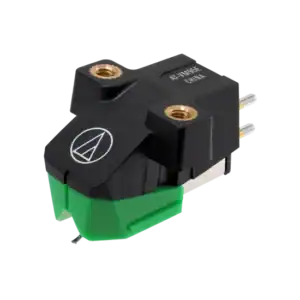
The VM95EN at $109 and VM95SH at $199 are significantly more affordable than most guides suggest. The full upgrade path from the included stylus to a near-reference Shibata tip costs $199 total and requires no tools. For full cartridge upgrade recommendations see the best turntable cartridges guide. Once you upgrade the stylus, the built-in preamp becomes the next limiting factor worth addressing.
Who Should Buy
You want one box that handles everything without buying a separate preamp, USB interface, or speed adapter. Plug into powered speakers and play. You plan to upgrade the stylus over time. The VM95 upgrade path is one of the best value progressions in hi-fi. You can take a $399 deck to near-reference cartridge performance for $199 in stylus upgrades without replacing anything else.
See the full best turntables guide for context on where every deck sits at every price. If you decide to add a separate phono stage, the Pro-Ject Phono Box DC at $149 is the natural first pairing: switch the deck to LINE, connect via RCA, and the improvement in noise floor is immediately audible.
How It Compares
The AT-LP60XBT at $259 is fully automatic and has Bluetooth, but it has a fixed non-upgradeable cartridge, no USB output, no 78 RPM, and significantly lower sound quality. The LP120XUSB costs $140 more and is a fundamentally different class of product. Check LP60XBT on Amazon.
The U-Turn Orbit Plus costs the same $399. Better-built plinth, more neutral sound, OA3 magnesium tonearm, acrylic platter. No built-in preamp standard (add ~$50 at order from U-Turn), no USB, no 78 RPM. If you own a phono stage or will buy one separately, the Orbit Plus is the better-sounding machine at the same price. Check Orbit Plus on Amazon.
The Rega Planar 1 (around $650 from authorized dealers) is the aspirational step up: a handmade RB110 tonearm, more dynamic and rhythmically engaging sound. No built-in preamp, no USB, no 78 RPM. According to What Hi-Fi’s five-star Rega Planar 1 review, the deck delivers a rhythmically engaging presentation that budget decks consistently struggle to match at any price.
Verdict: 8.5/10
The AT-LP120XUSB is the deck I point most first-time buyers toward, not because it sounds the best at $399 but because it asks nothing of you. Built-in preamp, USB output, 78 RPM, direct drive, upgradeable cartridge platform. Connect it to any powered speakers, play your records tonight, and spend the next two years deciding whether vinyl is genuinely for you. At $399 with nothing else required, it remains the most complete first deck available. The U-Turn Orbit Plus at the same $399 is the better-built and better-sounding alternative if you already own a phono stage or will add one. The phono preamps guide covers what to pair with either deck.
Audio-Technica AT-LP120XUSB Direct Drive Turntable
Frequently Asked Questions
Yes. The built-in preamp means you can connect it to any powered speakers without buying anything else. Setup takes under 20 minutes. The AT-VM95E cartridge tracks at 2 grams, which is safe for records, unlike ceramic styli on cheap suitcase players that track at 5 to 7 grams and cause permanent groove damage. The one caveat: this is a manual turntable, meaning you lower the needle yourself. If you want the tonearm to lift automatically at the end of a record, look at the Sony PS-LX310BT at $448 instead.
Yes. There is a PHONO/LINE switch on the back panel. Set it to PHONO when connecting to a receiver with a dedicated PHONO input. Set it to LINE when connecting to powered speakers or any AUX/LINE input. If you add an external phono stage, set the switch to LINE first. Running through two phono stages at once produces extreme distortion at high volume. This is the single most common setup mistake with this deck.
The AT-VM95E dual-magnet cartridge, pre-mounted on an AT-HS6 universal half-inch headshell. It has a 0.3 x 0.7 mil elliptical stylus and tracks at 2 grams. It is one of the better included cartridges at this price and is upgradeable across the entire VM95 stylus range without replacing the cartridge body.
Yes, and the upgrade path is excellent value. The AT-VM95E body accepts any VM95 Series stylus from the standard elliptical up to a Shibata tip without replacing the body or headshell. The VM95EN nude elliptical stylus is currently $109 on Amazon and is the best value upgrade. The VM95SH Shibata is $199. See the best turntable cartridges guide for full recommendations.
The U-Turn Orbit Plus costs the same $399 and has a denser, better-built plinth, OA3 magnesium tonearm, and acrylic platter, all of which produce better sound. It does not include a built-in preamp standard (optional ~$50 add-on from U-Turn directly), has no USB output, and no 78 RPM. The AT-LP120XUSB wins on features and convenience. The Orbit Plus wins on build quality and sound. If you own a preamp or will buy one separately, the Orbit Plus is the better turntable at the same price. Read the full U-Turn Orbit Plus review for the detailed comparison.
At $399 it is a harder recommendation than when it was priced at $299. The U-Turn Orbit Plus is now the same $399 and has better build quality and sound. That said, nothing else at $399 gives you direct drive, USB output, 78 RPM, a built-in preamp, and an upgradeable cartridge platform all in one box. If you want the most complete first deck under $400 without buying anything else, buy this. If you own a phono preamp, buy the Orbit Plus instead.
James Calloway has been collecting vinyl for 22 years. He spent six years working at an independent record store in Chicago, setting up and demonstrating turntables for customers at every budget. He has personally owned and tested more than 40 decks from entry-level belt drive to reference direct drive. He writes all turntable reviews and gear guides for VinylPickup.com.


