
Building the right record player with speakers means understanding three components: a turntable, a phono preamp, and a pair of speakers that work together. The key is knowing which of those three you can skip. Five systems here, from a $370 first setup to a $1,130 audiophile rig, each with specific products, verified total costs, and the one connection step that catches most first-time buyers out. If you already own one component and need to fill the gaps, the best turntables guide, best speakers guide, and best phono preamps guide cover each category independently.
Five Setups at a Glance
What You Actually Need (and What You Don’t)
Every vinyl setup has three elements in the signal chain: a turntable, a phono preamp, and an amplifier with speakers. The phono preamp applies the RIAA equalization that makes a vinyl signal sound correct. The good news is that in Setups 1 through 4, at least one component already includes the preamp and amplifier built in, so the component count stays at two boxes.
Setup 1: The Simple System

Audio-Technica AT-LP60X-BK Fully Automatic Belt-Drive Stereo Turntable
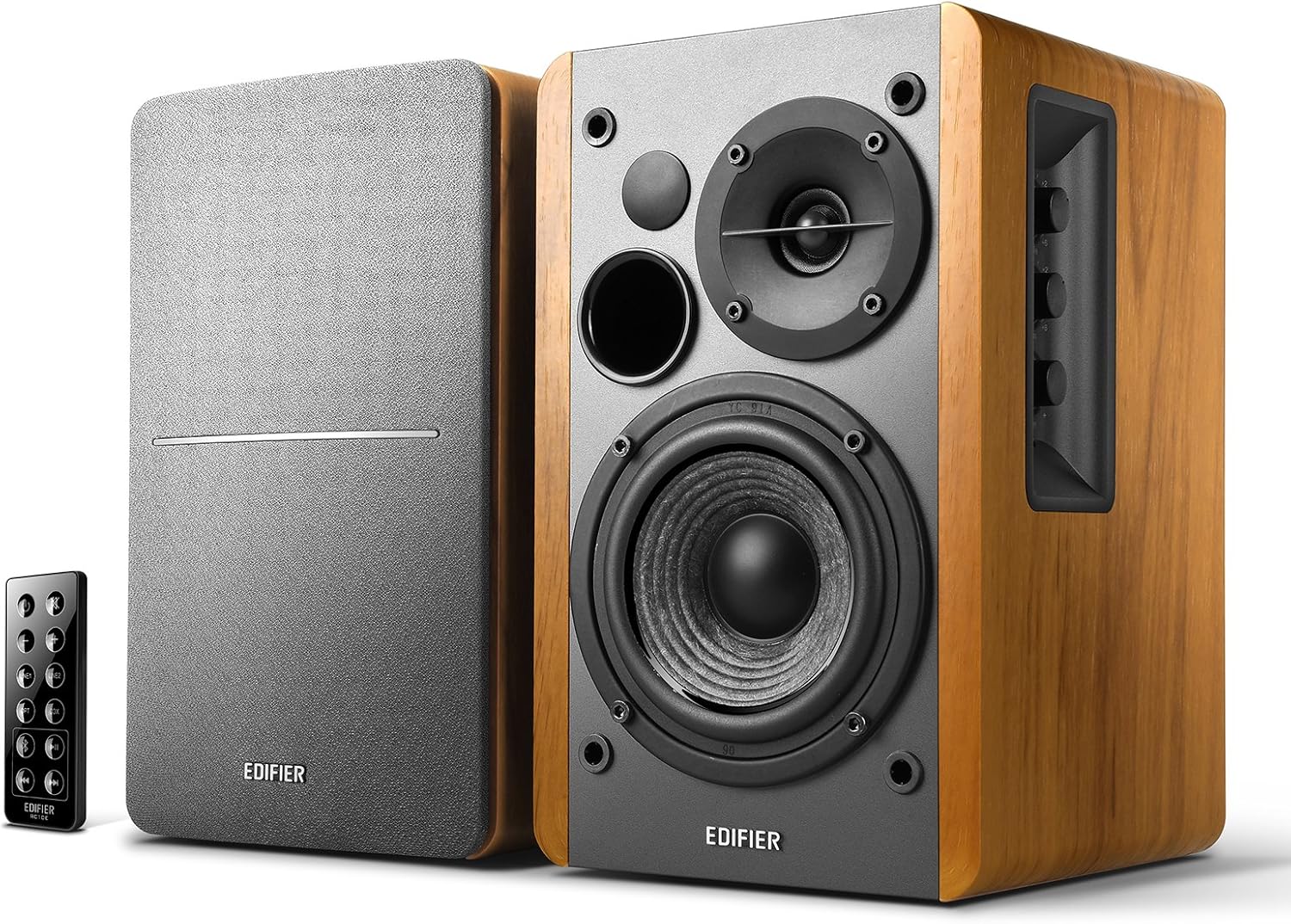
Edifier R1280DB Powered Bluetooth Bookshelf Speakers
The correct first system for anyone who wants to play records without thinking about components. The AT-LP60X is fully automatic: press a button, the tonearm lowers itself onto the record, lifts when the side ends. The Edifier R1280DB is a powered speaker pair with a built-in phono stage, Bluetooth, and optical input. The RCA cable that connects them is included with the turntable. At $179 for the deck and $189.99 for the speakers, the total sits around $370 and neither box requires anything else. Set the AT-LP60X PHONO/LINE switch to LINE, run the RCA cable to the Edifier LINE input, and play records. When the setup feels limiting, the Edifier stays. Upgrade to the AT-LP120XUSB and keep everything else exactly as it is.
Setup 2: The Best Value System
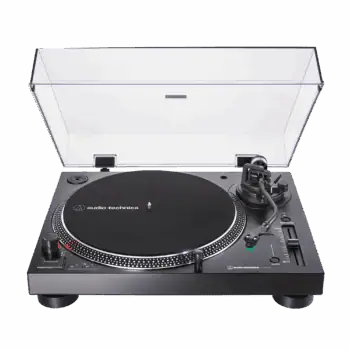
Audio-Technica AT-LP120XUSB-BK Direct-Drive Turntable
Edifier R1280DB Powered Bluetooth Bookshelf Speakers
The setup most people should build. The AT-LP120XUSB brings direct drive over belt drive for more stable speed, USB output for digitizing the collection, 78 RPM playback for shellac records, and the AT-VM95E cartridge whose 0.3×0.7 mil elliptical stylus upgrades to the VM95ML ($159) without removing the cartridge body. That upgrade path extends to a Shibata tip. The Edifier is identical to Setup 1 which confirms it is not the ceiling here. When ready to go further, keep the AT-LP120XUSB and replace only the Edifier with passive speakers and a dedicated amplifier. The turntable does not need to change. For most people who take vinyl seriously but are not ready for a four-component system, this is the setup they build and keep. Read the full AT-LP120XUSB review.
Setup 3: The Wireless System
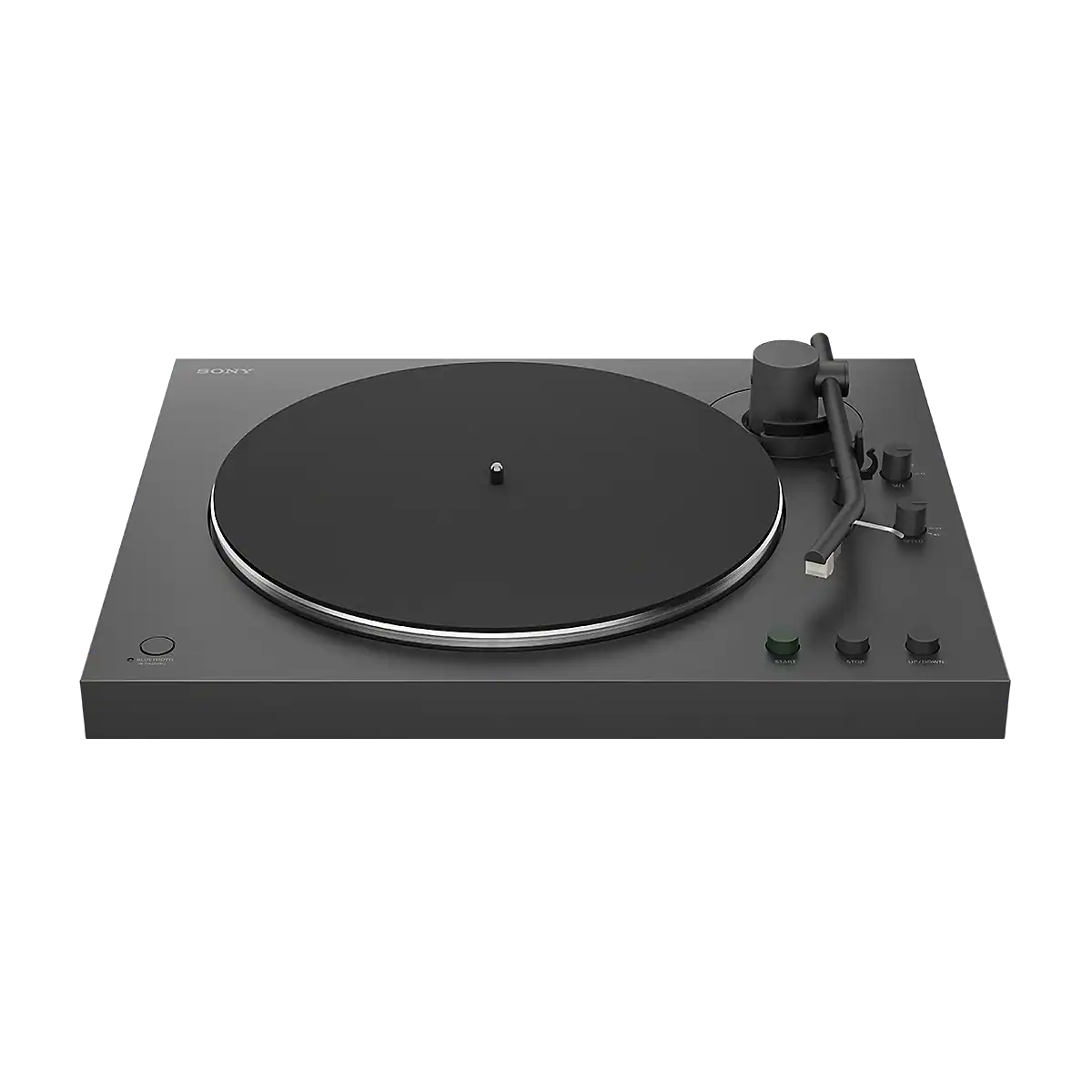
Sony PS-LX3BT Wireless Bluetooth Turntable 2026 Model
Edifier R1280DB Powered Bluetooth Bookshelf Speakers
The argument for this setup is room layout. If the turntable shelf and the speakers are on opposite sides of the room and running an RCA cable is not acceptable, the PS-LX3BT transmits via aptX Bluetooth to the Edifier’s Bluetooth input. No cable across the floor. The aptX codec delivers significantly better wireless quality than standard SBC, and at this system level the Bluetooth connection is not the weakest link in the chain. The PS-LX3BT is also fully automatic: the tonearm lowers and lifts without you touching it, which means both the cable problem and the “I forgot to lift the needle” problem are solved in one purchase. For a bedroom, home office, or any space where cable management matters, this is the correct choice over Setup 2 at the same price. Connect via the included RCA cable whenever you want the cleaner wired signal. The flexibility to switch between wired and wireless depending on what you are doing is a genuine advantage. See the full Bluetooth turntable guide for all wireless options.
Setup 4: The Mid-Range System
Audio-Technica AT-LP120XUSB-BK Direct-Drive Turntable

Klipsch R-51PM Powered Bluetooth Bookshelf Speakers
The best all-powered setup on the site. The Klipsch R-51PM uses a genuine Tractrix horn tweeter carried over from the passive Reference Premiere line. The horn disperses high frequencies more evenly across the room than a dome tweeter design, which is audible on well-recorded jazz, acoustic, and classical music. At 60W per channel with a built-in phono stage, Bluetooth, optical, and USB, the R-51PM handles every input the AT-LP120XUSB or any other component in the room might need. Both have built-in phono stages: set the AT-LP120XUSB switch to LINE and connect to the R-51PM LINE input. No preamp, no receiver, no additional hardware. The character to know: the Tractrix horn is revealing. It rewards well-recorded vinyl and tells you every flaw in aggressively mastered modern recordings. Read the full R-51PM review.
Setup 5: The Audiophile System
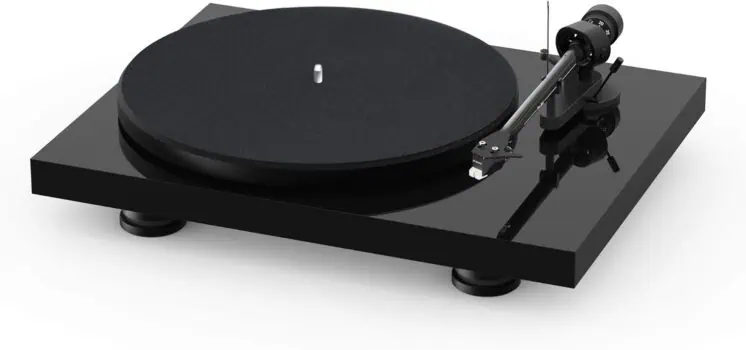
Pro-Ject Debut Carbon EVO Turntable with Sumiko Rainier Cartridge
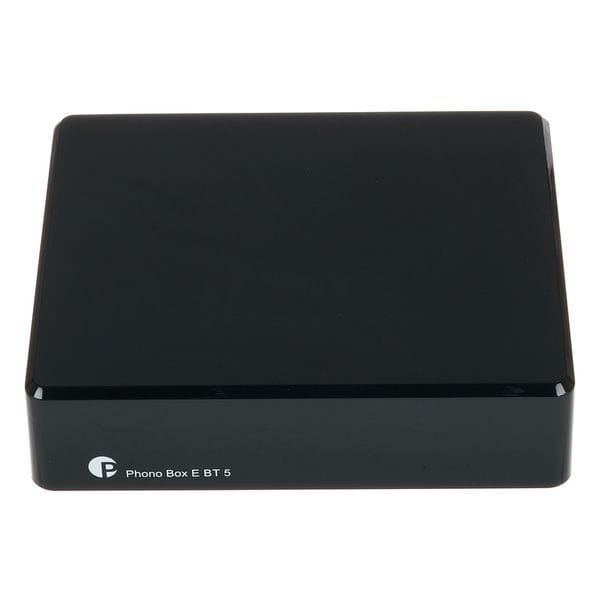
Pro-Ject Phono Box E BT5 Phono Preamplifier

Yamaha Audio A-S301BL Natural Sound Integrated Stereo Amplifier Black

Klipsch RP-600M Reference Premiere Bookshelf Speakers
Each component in this system is chosen for a specific reason. The Carbon EVO’s 8.6-inch carbon fiber tonearm has no built-in preamp, which is why the BT5 exists in the chain, and which is why the combination sounds better than any turntable with a built-in preamp at this price. The BT5 extracts more from the Sumiko Rainier cartridge than any plate amplifier built into a powered speaker. The Yamaha A-S301 is a dedicated 2-channel integrated amplifier: 45W per channel into 8 ohm, Pure Direct mode that bypasses the DAC and digital circuits entirely, and a genuine MM phono stage that means the BT5 can be bypassed if you want fewer boxes in the chain. The Klipsch RP-600M at 96dB sensitivity means the Yamaha runs comfortably within its operating range at any normal listening volume, which is where amplifiers reproduce music most accurately. The total system at ~$1,130 is a serious investment. The correct way to think about it: the tonearm outlasts the cartridge by decades, the amplifier outlasts the turntable, the speakers outlast everything. What Hi-Fi gave the Carbon EVO five stars and a Best Buy award, confirming its position as the benchmark belt-drive deck at this price. Read the full Carbon EVO review and the speakers guide.
How to Connect a Record Player to Speakers
Four scenarios. Find the one that matches your setup.
Scenario A: Setups 1, 2, or 3 (turntable with built-in preamp to powered speakers)
- Find the PHONO/LINE switch on the back of your turntable. Set it to LINE.
- Run the RCA cable from the turntable output (red and white plugs) into the Edifier LINE/AUX input. Do not use the Edifier PHONO input. The turntable’s built-in preamp handles that step.
- Power on the Edifier first, then the turntable.
- Start volume at zero. Raise slowly.
Scenario B: Setup 4 (AT-LP120XUSB to Klipsch R-51PM)
- Set AT-LP120XUSB PHONO/LINE switch to LINE.
- Run RCA cable from turntable output to R-51PM LINE input.
- Power on R-51PM, then turntable.
Alternative: Set switch to PHONO and connect to R-51PM PHONO input. Both methods work. Never use both phono stages simultaneously.
Scenario C: Setup 5 (Pro-Ject Carbon EVO to BT5 to Yamaha to RP-600M)
The Carbon EVO has no built-in preamp. This is the full 4-component chain.
- Carbon EVO RCA output → BT5 PHONO input.
- BT5 output RCA → Yamaha A-S301 AUX or CD input. Do not use the Yamaha PHONO input here. The BT5 has already applied equalization.
- Yamaha speaker terminals → Klipsch RP-600M via 16-gauge speaker wire.
- Power on: BT5 preamp first, then Yamaha amplifier, then Carbon EVO. Reverse order to shut down.
Scenario D: You already own a receiver with a PHONO input
Connect the turntable RCA output directly to the receiver’s PHONO input. No external preamp needed. Most receivers manufactured before 2000 have a PHONO input. Check the back panel before buying any additional hardware.
Never run two phono stages in series. If your turntable has a built-in preamp set to PHONO, do not connect it to another PHONO input. Two equalization stages in series produces loud distortion. Set the turntable switch to LINE and use an AUX or CD input instead.
Where to Put the Turntable
The most common setup mistake costs nothing to fix: turntable and speakers on the same surface. Speakers vibrate. Those vibrations travel through the furniture into the turntable’s platter and tonearm. The stylus reads them as signal and plays them back alongside the record. The result is muddier bass and degraded low-level detail that announces itself as something being slightly wrong without ever clearly explaining what.
The correct solution is separate furniture. Turntable on its own stand or shelf, speakers on speaker stands or a different surface entirely. Where that is not practical, isolation feet under the turntable absorb the vibration path. Keep at least 12 inches between the nearest speaker cabinet and the edge of the platter. The improvement when this is correct is not subtle and costs nothing.
Frequently Asked Questions
Yes, if the turntable has a built-in preamp (look for a PHONO/LINE switch on the back, set to LINE) and the speakers are powered with a LINE or AUX input. Every setup in this guide is configured so nothing extra is needed. If your turntable has no built-in preamp and your speakers have no PHONO input, you need an external phono preamp between them. The best phono preamps guide covers every option from $89.
A standard RCA cable (two plugs, red and white). Most turntables include one. If not, any standard RCA cable works. For Setup 5, you also need 16-gauge speaker wire to connect the Yamaha amplifier to the Klipsch RP-600M passive speakers.
Not for Setups 1, 2, 3, or 4. The preamp is built into the turntable in all four of those setups. For Setup 5, the Pro-Ject BT5 preamp is listed in the component breakdown and costs $152. If you have an amplifier with a PHONO input on the back, connect the turntable directly and skip any external preamp entirely.
Yes. The Sony PS-LX3BT (Setup 3) transmits via aptX Bluetooth to any compatible speaker. The Edifier R1280DB in Setups 1 and 2 also accepts Bluetooth input from any source. Wired RCA always sounds cleaner than Bluetooth, but the gap at this budget is not large enough to make Bluetooth the wrong choice.
Powered speakers have a built-in amplifier and connect directly from the turntable output. Passive speakers have no amplifier and require a separate integrated amp. At combined budgets above $700, passive speakers plus a dedicated amplifier consistently outperform powered speakers at the same total spend. Below $600, powered speakers are the correct choice for simplicity and value.
The correct minimum is ~$370 (Setup 1). Below that, the turntable either damages records or produces sound quality too poor to justify vinyl over streaming. Most people who take vinyl seriously end up at Setup 2 (~$590). Setup 5 at ~$1,130 is for people who know this is a long-term hobby and want equipment that grows with them.
Yes. If the receiver has a PHONO input on the back panel, connect the turntable directly. No additional hardware needed. If there is no PHONO input, add the Pro-Ject BT5 ($152) between the turntable and the receiver AUX input. Most receivers made before 2000 have a PHONO input.
Yes. Every setup in this guide is designed with an upgrade path. The AT-LP60X in Setup 1 upgrades to the AT-LP120XUSB (keep the Edifier). The Edifier in Setups 1 or 2 upgrades to the Klipsch RP-600M with the Yamaha A-S301 (keep the turntable). The Pro-Ject Carbon EVO in Setup 5 accepts cartridge upgrades within the Sumiko family and the full VM95 range without replacing the tonearm. Every component is independently upgradeable.
James Calloway has been collecting vinyl for 22 years. He spent six years working at an independent record store in Chicago where he advised customers on turntables, speakers, and complete vinyl systems across every budget. He writes all gear guides and record reviews for VinylPickup.com.


