
Most people learn about vinyl storage the wrong way. They buy a cheap shelf, fill it with records, and six months later notice that the records at the ends of each run are leaning at an angle. A year after that they pull out a record they have not played in a while and find the sleeve has developed a permanent crease along the spine. Two years in, in a collection that lives near a south-facing window or above a radiator, they find a record that has developed a very slight bow it did not have when they bought it.
None of this is inevitable. Records are durable objects when stored correctly. Upright, in correctly sized compartments with dividers to prevent leaning, in a room that stays reasonably cool and dry, a vinyl record will last longer than the person who owns it. The problem is that most furniture is not designed with the specific requirements of vinyl storage in mind, and the requirements are specific: compartments at least 33cm square, a structure that can carry the weight of records without sagging, and enough stability that the unit does not tip under a load of several hundred kilograms.
This guide covers every category from a first desktop stand through serious shelving for large collections. Before the products, the things worth understanding about why vinyl storage matters more than most people realise when they start buying records.
What Records Actually Need
A stack of 100 records laid flat weighs approximately 21kg including sleeves. The records at the bottom of that stack bear the full weight of everything above them. Vinyl is a thermoplastic. Under sustained pressure and temperature, it deforms. Not quickly, not dramatically, but persistently. A record stored flat for six months develops a very slight bow. A record stored flat for three years in a warm room develops a bow that affects playback. Store records upright. Always.
The correct compartment dimensions for 12-inch LPs are at minimum 33cm wide and 33cm deep. A standard 12-inch record with sleeve measures 31 to 32cm square. You need the extra clearance to get records in and out without forcing them against the shelf walls, which scuffs sleeves and, over time, tears them. IKEA’s Kallax has 33.5cm square compartments. This is not a coincidence. The design was influenced by the vinyl community’s requirements.
Weight is the thing most people underestimate. A full Kallax cube loaded with 80 records weighs approximately 20 to 23kg measured, which is well above IKEA’s official 13kg per compartment rating. Every serious record collector who uses Kallax units exceeds this limit. The units cope because they are oriented correctly, with the long structural boards running horizontally so the load travels down through the sides rather than stressing the shelf board. Units oriented the wrong way, or units that are not anchored to the wall, are a serious safety concern at full load. A fully loaded 4×4 Kallax holds 320 records and weighs upward of 80kg. If it tips, it causes significant damage and potential injury.
Dividers are not optional for any shelf run that is not completely full. Records that can lean do lean. Leaning records stress the spine of the outer sleeve, and over months that stress becomes a permanent crease. Over years it can cause the record itself to develop a slight warp at the edge. A set of wooden or acrylic LP dividers placed every 20 to 30 records costs a few dollars and prevents all of this.
Small Collections: Under 100 Records
Kaiu Record Storage Holder

Kaiu Record Storage Holder
Solid wood base with clear acrylic end panels. The clear ends let you see what is at each side of the run without pulling anything out. This is a small thing that turns out to matter when you are looking for a specific record quickly. It sits on a desk, a shelf, or the floor next to a turntable and holds 40 to 50 records at a sensible density.
The wood does not flex under a full load, which is the main structural requirement at this size. The limitation is real: at 50 records it is genuinely full and the records at the ends begin to lean outward slightly without the pressure of more records to hold them. At that point you either need dividers or you need more storage. If your collection is likely to pass 60 records in the next year, buy something larger now rather than replacing this later. The money goes further buying correctly once.
Monke Premium Vinyl Record Holder

Monke Premium Vinyl Record Holder
The Monke holds 50 to 60 records and adds one practical feature the Kaiu does not have: a dedicated groove at the front for displaying the record currently playing. A small thing but a genuinely useful one if you use your collection the way most people use their collection, pulling a record, playing it, and wanting to see what is on the platter. The acrylic construction is transparent throughout, which means you can see what is in the stand from any angle without pulling anything out.
At $36.95 it is slightly more than the Kaiu. The extra capacity (50 to 60 versus 40 to 50) and the now-playing groove are the meaningful differences. For someone who knows their collection is going to keep growing and wants a single desktop unit that will not be immediately outgrown, the Monke is the more sensible purchase. The same growth caveat applies to both: if you are likely to pass 70 records in the next year, step up to shelving.
Medium Collections: 100 to 500 Records
Lerliuo Record Player Stand

Lerliuo Record Player Stand
Three vertical compartments for records with dividers already included, plus two horizontal cubbies for a turntable and amplifier. The removable shelves in the cubbies accommodate different equipment heights. It does not look like audio equipment trying to pass as furniture. It looks like a piece of furniture that happens to work extremely well for records. This distinction matters in living rooms where the rest of the furniture has been chosen with some care.
Measure your turntable’s dust cover height before buying. The cubbies are generous but not unlimited, and some larger turntables with tall dust covers will not fit closed. Reviewers on Amazon consistently note the sturdy build and usable space relative to the footprint. At $89.99 for something that handles records, turntable and amplifier in a single unit with a real mid-century look, this is a reasonable proposition for a living room setup that needs to look intentional.
IKEA Kallax
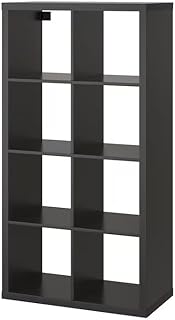
IKEA Kallax Shelving Unit
The Kallax is the default answer for vinyl storage worldwide and has been since its predecessor the Expedit was introduced decades ago. The 33.5cm square compartments hold 70 to 80 records each at a comfortable browsing density. The unit is available in single-cube to 5×5 configurations. It is modular, so when your collection outgrows a 2×4, you add a second unit rather than replacing the first. At the price point, there is nothing that competes with it on value for the purpose.
The two things IKEA does not tell you that the vinyl community has learned through collective experience:
First, orientation. A 2×4 Kallax must be installed with the four-cube dimension running vertically, not horizontally. The long structural boards must run horizontally across the unit. In this orientation the weight of the records travels down through the side panels, which are the load-bearing members. In the wrong orientation, the weight is carried by the shelf boards, which sag significantly under record weight over time. This is not a minor caveat. It is the difference between a unit that lasts twenty years and one that develops visible sag within two.
Second, wall anchoring. A fully loaded 4×4 Kallax holds around 320 records and weighs upward of 80kg. This unit must be anchored to the wall. IKEA includes anchor hardware with every Kallax unit specifically because they know the physics. Using it is not optional. A collector in a Discogs forum thread on this subject described filling a 4×4 unit over several years to discover it had developed a significant lean toward the front that was only arrested by a nearby piece of furniture. Wall anchoring takes five minutes and prevents the unit from becoming a serious hazard.
Large Collections: 500 Records and Up
Three properly oriented and wall-anchored 4×4 Kallax units will hold 500 to 600 records comfortably. This is the setup most serious collectors with living room space use. The units can be arranged against a single wall as a unified run of shelving, stacked two high if ceiling height allows (securing the upper units to the lower units and the wall), or spread across multiple walls to distribute the weight load on the floor.
The alternative at this scale is custom built-in shelving. A carpenter building floor-to-ceiling shelving to the correct vinyl dimensions will produce something that holds more records, looks better in the room, and is more structurally stable than any flat-pack solution. The cost is significantly higher but for a collection that has reached 500 records and is not going to stop growing, commissioning proper built-ins once is usually less expensive over a decade than repeatedly buying, rearranging and replacing flat-pack units.
At this scale the Discogs community forum on Kallax storage is worth reading before making any decisions. It contains years of practical experience from collectors with collections in the thousands, covering every failure mode and the specific practices that prevent each one.
Storage Boxes for Transport and Overflow
BCW Record Storage Box

BCW Vinyl Record Storage Box
BCW makes the boxes that record stores and record labels use for archival storage and shipping. The construction is reinforced specifically for vinyl weight, the dimensions are correct for 12-inch records, and the boxes stack without collapsing under load. Currently sold in a 5-pack at $80.59 ($16.12 per box). If you are moving house or storing records temporarily while shelving is being installed, these are the correct boxes for the job.
The critical caveat: temperature and humidity matter significantly more to boxed records than to shelved ones. A shelved record in a warm room develops minor sleeve softening at worst. A boxed record in a hot attic or a damp basement can warp permanently within a single summer. The physics are simple: the box insulates the records against temperature equalisation. If you box records for anything beyond short-term storage, keep the boxes in a climate-controlled environment and open them periodically to check.
The Three Things Every Collection Needs
Outer protective sleeves are clear plastic sleeves that fit over the entire album jacket. Without them, every time you pull a record from the shelf the jacket picks up a micro-scuff from the adjacent record or from the shelf wall. Over six months of regular use this is minor. Over five years it is visible damage to every sleeve in the collection. Outer sleeves cost a small amount in bulk and the protection is permanent and cumulative. Buy them in the same order as your first storage unit.
BCW Outer Record Sleeves

BCW Outer Record Sleeves
Inner sleeves are the paper or polyethylene sleeve that holds the record inside the jacket. Many original inner sleeves in records pressed before the 1990s are made from paper that has become acidic with age. Acidic paper in sustained contact with a vinyl record causes very slow but real surface degradation. It shows up as a slight haziness that does not clean off. Replacing original paper inner sleeves with anti-static polyethylene or rice paper inner sleeves eliminates the risk entirely. Keep the original paper sleeve inside the jacket, behind the new inner sleeve, for the sake of completeness. For collectors of original pressings, the original sleeve is part of the item. Do not discard it, just move it out of contact with the record itself.
Mobile Fidelity Inner Sleeves

Mobile Fidelity Inner Sleeves
Dividers belong in every shelf run that is not completely full. The specific problem they prevent: when a run of records has empty space at one end, the records at that end lean outward. The outermost record takes the full stress of supporting everything leaning against it. The spine of its sleeve develops a crease. Over years it can develop a slight warp at the edge. A wooden or acrylic divider placed every 20 to 30 records costs almost nothing and prevents this entirely. Buy them when you buy the shelving, not after you notice the problem.
Frequently Asked Questions
Always upright on their edges in a correctly sized compartment with dividers to prevent leaning. Never flat. Flat storage causes warping from the weight of records stacked on top of each other. The compartment needs to be at least 33cm wide and 33cm deep for 12-inch LPs.
70 to 80 records at a comfortable browsing density. You can physically fit up to 90 but the records become difficult to access and the pressure on outer sleeves increases. 70 to 80 is the practical working maximum.
Yes, with two conditions. The long structural boards must run horizontally, which means a 2×4 unit has the four-cube dimension running vertically. And the unit must be anchored to the wall. Fully loaded Kallax units exceed the official 13kg per compartment rating, but correctly oriented and anchored units have held full record collections for decades without issue.
Not ideally. Boxes insulate records against temperature equalisation, so the records inside experience more extreme temperature swings than shelved records do. In a hot attic or damp basement, boxed records can warp permanently within a single summer. For temporary storage or moving house, BCW storage boxes are the right choice. For anything longer than a few months, proper shelving is required.
Yes. Every time you pull a record from a shelf without an outer sleeve, the jacket picks up micro-abrasion from adjacent records and the shelf wall. Over years this becomes visible damage to every sleeve. BCW outer sleeves cost around $22.85 for 100 and the protection is permanent.
Avoid direct sunlight, which causes sleeve fading and record warping with prolonged exposure. Avoid proximity to radiators and heating vents. Avoid damp basements or garages where humidity fluctuates significantly. Avoid anywhere the temperature regularly exceeds 20 degrees Celsius for extended periods.
James Calloway has been collecting vinyl for 22 years. He spent six years working at an independent record store in Chicago. He writes all record guides and gear reviews for VinylPickup.com.


