
Record Player Needle Replacement: When to Do It and What to Buy
A worn needle does not just sound bad. It physically damages your records with every play. The diamond tip cuts deeper into groove walls than it should, and that damage is permanent. By the time most people notice the sound has degraded, they have already done weeks of harm to pressings they cannot replace. This guide tells you when to change your turntable needle, which replacement fits your specific deck, and whether the stylus is worth replacing or upgrading. If you own one of the turntables reviewed on this site, the answer is already worked out below.
Six years behind a record store counter taught me one reliable fact: most people replace their stylus too late. The second most common mistake is buying the wrong replacement. Below you will find the exact replacement for your specific deck, the honest case for whether an upgrade is worth it, and a step-by-step replacement guide with official video for each turntable type. If you are still deciding on a turntable, the best turntables of 2026 covers every deck worth buying. If the needle is fine but the sound still is not right, the best phono preamps guide is the next place to look.
- Unplug the turntable and move the tonearm to its rest
- Locate the stylus on the cartridge at the front of the tonearm
- Grip the stylus body at its base and pull straight forward until it releases
- Press the new stylus straight onto the cartridge body until it clicks
- Confirm tracking force with a digital scale before playing a record
How Long Does a Record Player Needle Last?
The diamond tip on a stylus wears down through contact with vinyl grooves. It does not happen overnight, and it does not announce itself. The sound gets gradually duller, sibilants get harsher, and surface noise increases on records that used to play quietly. By the time the problem is obvious, the worn tip has been dragging through groove walls for months, scraping off material that cannot be put back.
Stylus life varies by type. A bonded conical tip, the kind fitted to most entry-level decks including the AT-LP60X, is rated at 300 to 500 hours before quality begins to degrade. A bonded elliptical like the Ortofon 2M Red runs 500 to 1,000 hours. A nude elliptical like the 2M Blue can reach 800 to 1,200 hours with clean records and proper care. Nude microlinear styli such as the AT-VMN95ML are rated at up to 1,000 hours. These figures assume the record is clean before every play and the stylus is brushed before each session. Skipping either cuts the lifespan significantly.
Signs Your Needle Needs Replacing
The most reliable test: play Joni Mitchell’s Blue, specifically “River.” The sustained sibilant sounds in that track are among the most demanding passages for a stylus. A fresh needle handles them cleanly. A worn one introduces a harsh, distorted edge on the “s” sounds that was not there before. If you hear that on a clean pressing you know well, the stylus is the first thing to check.
Needle vs Cartridge: What You Actually Need
The stylus is the diamond tip and the cantilever it sits on. It is the part that touches your records. On most turntables, the stylus clips onto the front of the cartridge body and can be removed without tools. The cartridge is the larger body housing the engine, coils, and magnets. It converts the mechanical vibration of the stylus into an electrical signal.
In 90% of cases, a worn turntable needle means you need a new stylus, not a new cartridge. The cartridge body lasts far longer than the tip. The exception is when the body is physically damaged, when you want to change to a completely different brand or cartridge type, or when the stylus is fixed to the body and cannot be removed separately. Fixed-stylus cartridges are found mostly on cheap suitcase-style record players, not on any of the decks covered in this guide.
- ✔Sound has degraded but the cartridge body is intact
- ✔You want to stay with the same brand and series
- ✔Your stylus snaps cleanly off the cartridge body
- ✔You own a 2M Red and want to upgrade to 2M Blue level
- ✔The cartridge body is cracked, bent, or the coils are damaged
- ✔You want to change brands entirely
- ✔Your turntable has a removable headshell and you want a genuine upgrade
- ✔The stylus is not removable from the current body
Replacement Needle by Turntable Model
Audio-Technica AT-LP60X
The AT-LP60X has a fixed headshell. The stylus snaps off the cartridge body forward and presses straight back on. No tools, no alignment, no headshell removal. The stock cartridge is the AT3600L with a conical tip. You cannot fit a different brand cartridge to the AT-LP60X without modifying the tonearm, so the upgrade path stays within the Audio-Technica ATN series.

Audio-Technica ATN3600LC Conical Replacement Stylus
For noticeably better sound from the same deck, the ATN3600LE is worth the extra $10. It uses an elliptical tip rather than a conical, which means better contact with the groove walls, tighter stereo separation, and cleaner sibilants. Same snap-on installation, no realignment required.

Audio-Technica ATN3600LE Elliptical Upgrade Stylus
Audio-Technica AT-LP120XUSB
The AT-LP120XUSB ships with an AT-VM95E cartridge fitted to a removable headshell. When it wears out, the direct replacement is another AT-VM95E. The headshell removes by loosening the collar at the tonearm connection, making cartridge swaps straightforward. See the step-by-step section below for the full process on this deck.

Audio-Technica AT-VM95E Dual Moving Magnet Cartridge
The meaningful upgrade for the AT-LP120XUSB is the AT-VMN95ML stylus. It snaps onto the existing VM95E cartridge body with no realignment. The microlinear tip has a smaller contact patch than the elliptical, resolves inner grooves with more accuracy, and retrieves high-frequency detail the elliptical cannot reach. The full comparison is in the best turntable cartridges guide.

Audio-Technica AT-VMN95ML Microlinear Replacement Stylus
U-Turn Orbit Plus
The Orbit Plus ships with an Ortofon OM5e cartridge. The stylus snaps off forward and presses back on, same as the Audio-Technica series. The OM platform accepts several stylus upgrades on the same body with no realignment needed. The direct stock replacement is the OM-5e stylus. The Stylus 10 is a step up at almost the same price, with a tighter, more defined sound due to its improved tip geometry.

Ortofon Replacement Stylus OM-5e

Ortofon Replacement Stylus 10
If the Orbit Plus is your main deck and you want a genuine sound upgrade rather than a like-for-like replacement, the Ortofon 2M Red is worth considering. It requires a full cartridge swap with alignment, but the Orbit Plus’s removable headshell makes the process manageable. The 2M Red opens the upgrade path to the 2M Blue stylus later without remounting anything.
Fluance RT85
The RT85 ships from the factory with an Ortofon 2M Blue already fitted. When it wears out, the correct replacement is the 2M Blue replacement stylus, not the full cartridge. Pull the stylus straight off the body and press the new one on. No tools, no realignment. After 800 to 1,200 hours the nude elliptical tip rounds off enough that inner groove passages lose the precision that distinguishes the Blue from cheaper cartridges — sibilants become harder, the noise floor rises, and the stereo image narrows. Those are the signs the stylus needs replacing, not the deck. What the 2M Blue sounds like when fresh is covered in the Ortofon 2M Blue review.

Ortofon Replacement Stylus 2M Blue
Sony PS-LX310BT
The Sony PS-LX310BT uses an integrated AT3600L cartridge. The stylus is replaceable but the cartridge body cannot accept third-party alternatives. Sony’s own FAQ confirms the tonearm is tuned specifically for the original cartridge. When the stylus wears out, order Sony’s official replacement (part number 9-301-000-82) from an authorised dealer. TurntableLab stocks it reliably at approximately $30.
Denon DP-300F
The DP-300F uses the Denon DSN-85 cartridge with a conical stylus. The official replacement is the DSN-85, sold by Denon directly on Amazon. The DP-300F also has a removable headshell. Swapping the DSN-85 for an Ortofon 2M Red brings a clear improvement in detail, stereo separation, and inner groove clarity: the difference between the conical and elliptical tips is plainly audible on this deck through any decent phono stage. The Denon DP-300F review covers the full upgrade path.

Denon DSN-85 MM Replacement Stylus
Pro-Ject Debut Carbon EVO
The Carbon EVO ships with an Ortofon 2M Red. When the stylus wears out, the better option is to upgrade to the 2M Blue stylus rather than replace like-for-like. The Blue snaps directly onto the Red body, no tools and no realignment. The Carbon EVO’s tonearm resolves the difference clearly: the lower noise floor, wider stereo image, and cleaner inner groove performance the Blue delivers are all audible on this deck. The full argument for doing this rather than a straight replacement is in the Ortofon 2M Blue review.
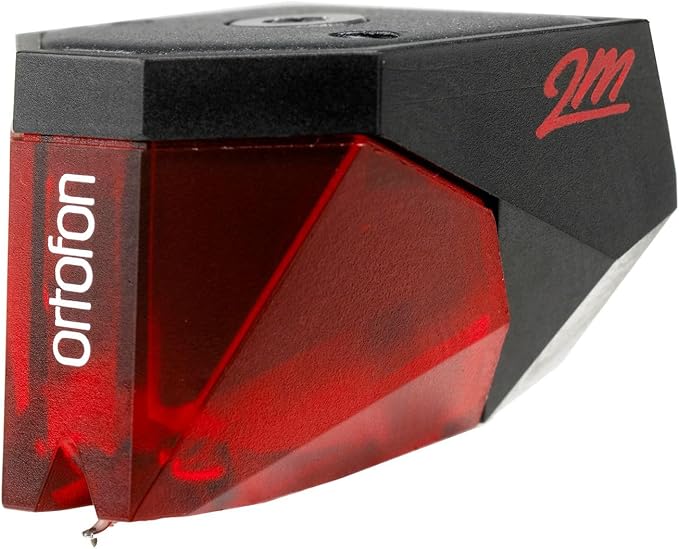
Ortofon 2M Red Moving Magnet Phono Cartridge
Should You Replace or Upgrade?
Replacing like-for-like makes sense if you are happy with the sound, your deck is under $300, or the budget does not stretch further right now. A clean stock stylus tracks correctly and protects your records. That is the job.
Upgrading makes sense when your deck is $400 or above, you have specific complaints about the current sound (harsh sibilants, inner groove distortion, dull upper midrange), and you have a phono stage that can reveal the improvement. A better stylus for a record player costing $200 will make a small difference. The same stylus on a $600 deck through a dedicated phono stage is a genuinely different listening experience. The system around the cartridge determines how much of the upgrade you actually hear.
How to Replace Your Record Player Needle or Turntable Stylus
Snap-off Stylus Replacement (AT-LP60X series)
The official Audio-Technica tutorial below covers the AT-LP60X series specifically and demonstrates both the stock replacement and the elliptical upgrade process.
- Unplug the turntable. Always work with the power off.
- Move the tonearm to its rest and engage the locking clamp if your deck has one.
- Locate the stylus. It is the small body at the front of the cartridge with the needle tip pointing down toward the record.
- Grip the stylus body at its base, not the tip or cantilever. Pull straight forward with steady pressure. It will resist slightly and then release. A gentle side-to-side rocking motion helps if it feels stuck.
- Install the new stylus by pressing it straight onto the cartridge body from the front until it clicks into place.
- Check tracking force with a digital scale before playing anything. The correct figure for each stylus is listed in the product section above.
Headshell Removal (AT-LP120XUSB, U-Turn Orbit Plus, Denon DP-300F, Pro-Ject Debut Carbon EVO)
Decks with removable headshells allow more upgrade flexibility but require additional steps. The video below covers the general process for Audio-Technica and most other standard-mount turntables.
- Unplug the turntable and secure the tonearm to its rest.
- Photograph the wire connections before touching anything. Four wires connect to the cartridge pins: white (left channel), red (right channel), green (left ground), blue (right ground). The colour code is standard but the photo is cheap insurance.
- Remove the headshell by loosening the locking collar at the tonearm connection and pulling it straight off.
- Disconnect the wires using needle-nose pliers or tweezers. Pull by the connector, not the wire itself.
- Unscrew the old cartridge from the headshell. Keep the mounting screws somewhere they cannot roll away.
- Mount the new cartridge loosely. Do not tighten the screws fully yet as you need to adjust alignment first.
- Reconnect the wires using your photo as reference. White to left, red to right, green to left ground, blue to right ground.
- Align the cartridge using a Baerwald protractor. Place the stylus tip on each null point and adjust the cartridge until the cantilever runs parallel to the alignment lines. A free printable protractor is available from the Vinyl Engine cartridge database.
- Tighten the mounting screws once aligned, reinstall the headshell, and set tracking force with a digital scale.
Replace it every 500 to 1,000 hours of play depending on stylus type. A bonded conical (AT-LP60X stock) lasts 300 to 500 hours. A bonded elliptical like the 2M Red lasts 500 to 1,000 hours. A nude elliptical or microlinear can reach 800 to 1,200 hours with proper care. At five hours of listening per week, that is one to four years. If you are not tracking hours, replace every two years regardless and do a visual check with a loupe annually.
Find your turntable model in the section above. Every turntable reviewed on this site has a specific replacement and upgrade listed with verified Amazon links. For other decks, check the manual for the cartridge model number, then search for that model number followed by replacement stylus. Do not buy universal or generic styli: they rarely fit correctly and can damage the cartridge body.
Yes, and the damage is permanent. A worn diamond tip develops flat or uneven surfaces that scrape groove walls instead of tracing them cleanly. The microscopic damage accumulates with every play. Records played on a worn needle for an extended period will have elevated surface noise and reduced high-frequency detail that cannot be recovered. This is the main reason to replace proactively rather than waiting for obvious sound degradation.
Replacing means putting the same stylus back on. Upgrading means fitting a better stylus on the same cartridge body or fitting an entirely new cartridge. An upgrade typically means moving from a conical to an elliptical tip, or from a bonded elliptical to a nude elliptical. A nude stylus sits deeper in the groove, follows the groove walls with greater accuracy, and handles inner groove passages more cleanly. Whether the upgrade is audible depends on your deck: on a $200 turntable the improvement is modest; on a $500 turntable with a quality phono stage it is clearly noticeable.
The AT-LP60X stylus snaps off forward and presses back on. No tools required. Unplug the deck, secure the tonearm, grip the stylus body at its base (not the tip), and pull straight forward until it releases. Press the new stylus on until it clicks. Check tracking force with a digital scale before playing. Stock replacement is the ATN3600LC at $36. Elliptical upgrade is the ATN3600LE at $46. You cannot fit a different brand cartridge to the AT-LP60X without modifying the tonearm.
Depends on the deck. The Sony PS-LX310BT stylus is replaceable using Sony part number 9-301-000-82, but the cartridge body cannot be swapped for third-party alternatives. The AT-LP60X stylus snaps off and is replaceable using the ATN3600LC or ATN3600LE. Cheap suitcase-style record players often have completely fixed needles that cannot be replaced at all. If you cannot find a specific replacement stylus listed for your model number, contact the manufacturer before buying anything.
James Calloway has been collecting vinyl for 22 years. He spent six years working at an independent record store in Chicago, where he replaced and upgraded styli on more customer turntables than he can count. He writes all gear guides and reviews for VinylPickup.com.


