
Home / Turntables / Review
TurntablesAudio-Technica AT-LP70X Review
The best value automatic turntable: as easy as the LP60X, a little better sounding, with a stylus that can grow.
Best value automatic turntable
As easy as the LP60X, a little better sounding, and a stylus that can grow.
Upgradeability is 8.0, not higher: the stylus upgrades, but the cartridge body, tracking force and anti-skate are fixed.
- ✓You want press-Start simplicity with powered speakers
- ✓You plan to upgrade the stylus later
- ✓You are choosing between it and the AT-LP60X
- ✕You want to experiment with cartridges
- ✕You want to adjust tracking force or anti-skate
- ✕You need Bluetooth: get the AT-LP70XBT
Full test method
7 days and about 12 hours of play, side by side with the AT-LP60X, into Edifier R1280DB powered speakers over RCA, built-in preamp on LINE. Then one full side a day for 30 days, to check for skipping. Records: Aja, In Rainbows, Time Out and a 7-inch single. Our testing method
What Works
- ✓Press Start and walk away: smooth, dependable auto start and return
- ✓A little better than the LP60X: tighter bass, better separation
- ✓VM95 stylus you can upgrade, starting with the elliptical VMN95E
- ✓Low-noise built-in preamp: no external preamp needed
What Does Not
- −Tracking force and anti-skate are fixed
- −Light plastic build, non-adjustable feet, short RCA cable
- −The mechanism is audible in a quiet room
- −Skipping reported on some units: check yours early
Setup and Build
In shortAbout the easiest turntable setup there is. The trade-off is a light, plastic build.
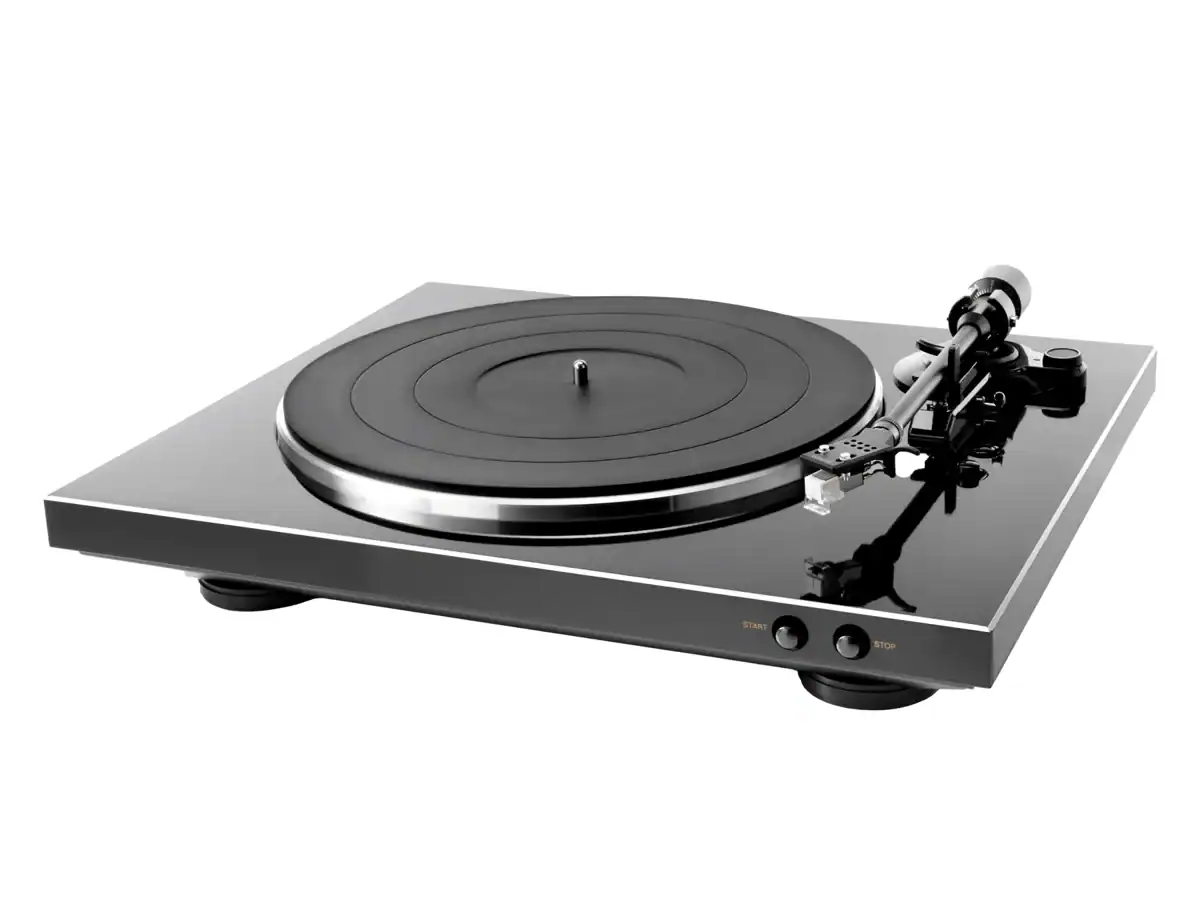
The cartridge comes installed and tracking force and anti-skate are set at the factory: there is no counterweight to balance. Setup takes five steps and a few minutes; for a complete system, our vinyl setup guide covers speakers and placement.
- 1Place the platterDrop the aluminum platter onto the spindle.
- 2Fit the beltPull the belt over the motor pulley with the attached ribbon, then remove the ribbon.
- 3Add mat and lidLay the felt mat and slot in the dust cover hinges.
- 4Turn it ten timesRotate the platter ten times by hand to seat the belt and reset the automatics.
- 5Set LINE and connectSwitch to LINE and run the RCA cable to powered speakers.
Official setup video from Audio-Technica USA. It plays from YouTube when you press play.
Step four matters more than it looks: turning the platter ten times settles the belt and resets the automatic mechanism, and it is worth repeating if anything behaves oddly later.
That said, the body is mostly plastic, and at about 6.4 pounds it lacks the weight of pricier decks. Also, the feet are not adjustable, so it needs a level surface, and the included RCA cable is only about 3.3 feet long. The J-shaped tonearm and VM95 cartridge look more substantial than the LP60X's.
Sound Quality
In shortBalanced and pleasant, a little better than the LP60X. The conical stylus limits the finest detail.
The LP70X is neither especially warm nor bright: a balanced presentation that suits most records. It is not an audiophile turntable, but nothing about it sounds obviously cheap. Here is what we heard, record by record, through the built-in preamp and the Edifiers.
The bass had decent weight, the vocals sat nicely centered, and the drums were punchy without turning muddy.
Low end: goodPercussion came through clearly, without the sharpness of many cheap cartridges, but cymbals lacked the air and fine detail of an elliptical stylus.
Treble: limited by the stylusThe saxophone sounded full and natural and the piano clear enough to follow note by note; toward the inner grooves the top end got slightly less tidy on louder passages.
Inner grooves: slightly untidyThe softer treble and the untidy inner grooves are the stock conical stylus talking, and they are exactly what the first upgrade fixes.

The Automatic Mechanism
In shortSmooth and dependable in our test. Audible, but masked once the music starts.
Press Start and the platter spins up, the arm moves over and the stylus lowers onto the record; at the end of the side the arm lifts, returns and the platter stops. The lowering is smooth. Still, there is a little audible movement when the mechanism engages and a faint motor whir in a quiet room, both masked by the music. The Stop button needs a more deliberate push than you would expect. Overall, in our week of testing the arm returned correctly every time, with no repeated skips or tracking failures.
Change two settings: the speed button and the record-size selector by the tonearm. Forgetting the selector is the most common surprise if you usually play 12-inch LPs.
The Built-In Preamp
In shortBetter than expected for the category. No urgent need for an external one.
Through the Edifiers, background noise stayed low at normal listening levels; with the volume turned well up between tracks some hiss appeared, not necessarily all from the turntable. In practice, for powered speakers, leave the switch on LINE. On the other hand, if you later add a separate phono preamp, switch to PHONO and connect the ground. It applies the RIAA equalization every record needs, so the speakers get a normal line-level signal. For a beginner system we would keep the built-in stage and spend upgrade money elsewhere first, starting with the stylus. When you are ready, our phono preamp guide picks up from there.
Known Issue: Skipping and Looping
In shortOur unit played 30 sides over a month without a single skip. But skipping is the most common owner complaint about the LP70X, so check yours carefully.
What owners report
Skipping and looping reports have been the dominant complaint about the LP70X. Best Buy reviewers describe returning units for it, some more than once, and some say it began weeks after purchase; in early 2025 owners on Reddit's r/turntables noticed a surge of skipping posts. Audio-Technica attributes the problem to inconsistent tonearm lubrication on early production units, says it has been corrected, and services affected turntables through a skipping service form for both the LP70X and LP70XBT, though at least one owner reported being asked to pay the shipping. Our test unit returned correctly and tracked cleanly through 12 hours of side-by-side testing, and then through a month of daily sides (below). It is not a reason to skip the LP70X. However, it is a reason to buy where returns are easy and to check it early.
Our 30-day skip log
To test the reports properly, we played one full side every day for 30 days and let every side run to the automatic return; pressing Stop did not count. Same deck, same settings as our main test: stock VM95C, preamp on LINE, record-size selector on 12 inches.
- 1RumoursA✓
- 2RumoursB✓
- 3AjaA✓
- 4AjaB✓
- 5Time OutA✓
- 6Time OutB✓
- 7Kind of BlueA✓
- 8Kind of BlueB✓
- 9In RainbowsA•
- 10In RainbowsB✓
- 11London CallingLP1 A✓
- 12London CallingLP2 B✓
- 13RumoursA✓
- 14RumoursB✓
- 15AjaA✓
- 16AjaB✓
- 17Time OutA✓
- 18Time OutB✓
- 19Kind of BlueA✓
- 20Kind of BlueB✓
- 21In RainbowsA•
- 22In RainbowsB✓
- 23London CallingLP1 A✓
- 24London CallingLP2 B✓
- 25RumoursA✓
- 26RumoursB✓
- 27AjaA✓
- 28AjaB✓
- 29Time OutA✓
- 30Time OutB✓
The two dots are the same In Rainbows side: a surface tick that came back at exactly the same spot the next time, which means a mark on the record, not the deck. This is one unit and 30 sides of 12-inch LPs at 33 rpm, so it cannot tell you how often the fault happens, only that a working LP70X behaves like this. If yours skips on clean records on a level surface, send it in for service rather than adding weight to the headshell.
Six checks for a new LP70X
The Stylus Upgrade Path
In shortThe real reason to choose the LP70X: a stylus you can upgrade. Start with the elliptical VMN95E, and stop there.
The AT-VM95C body is fixed, but the stylus pulls out and any VM95-series stylus fits. More detail costs more, and past the elliptical the fixed tracking force limits what you gain. If you outgrow the stylus path entirely, our cartridge guide covers decks with removable headshells.

How It Compares
We tested the LP70X against the LP60X; the LP70XBT shares its hardware; the Denon DP-300F is the automatic for changing cartridges.


tested
Pair It With

More speaker options in our best speakers for a record player guide.
Step up to a manual deck: the AT-LP120XUSB

Adjustable tracking force, a removable headshell for any cartridge, and direct drive. You lower the arm yourself. See it in our best turntables guide.
Specs at a Glance
| Operation | Fully automatic start and return |
|---|---|
| Drive | Belt |
| Speeds | 33 1/3 and 45 RPM, with a record-size selector |
| Cartridge | Audio-Technica AT-VM95C, fixed body |
| Stock stylus | VMN95C conical (0.6 mil) |
| Stylus upgrades | Any VM95-series stylus: elliptical, microlinear, Shibata |
| Tracking force and anti-skate | Factory-set, not adjustable |
| Phono preamp | Built in, switchable PHONO/LINE |
| Outputs | RCA, detachable cable (about 3.3 feet) |
| Bluetooth | No (the AT-LP70XBT adds it) |
| Platter | Aluminum |
| Weight | About 6.4 pounds |
Full specifications are on Audio-Technica's official AT-LP70X page, along with the manual and warranty details.
What Other Reviewers and Owners Say
Final Verdict

Questions Buyers Ask
Is the Audio-Technica AT-LP70X worth it?
Yes, for anyone who wants a simple automatic turntable for powered speakers. In our test it sounded a little better than the AT-LP60X and adds a VM95 stylus you can upgrade, with the same easy setup.
AT-LP70X vs AT-LP60X: which is better?
The AT-LP70X. We tested them side by side: it has slightly tighter bass and better separation, and its VM95 stylus can be upgraded to elliptical and beyond. The LP60X remains the cheaper choice when every dollar counts.
Why does my AT-LP70X skip?
Ours did not: it played 30 sides over a month without a skip. If yours does, clean the record and stylus, make sure the deck is level and away from the speakers, and turn the platter ten times by hand to settle the belt. If clean records still skip or loop, contact the seller or Audio-Technica: some early units had tonearm lubrication problems, which Audio-Technica services.
What is the best stylus upgrade for the AT-LP70X?
The elliptical Audio-Technica VMN95E. It improves treble detail and inner-groove sound, and it suits a deck with fixed tracking force better than the pricier microlinear or Shibata styli.
Can you adjust the tracking force on the AT-LP70X?
No. Tracking force and anti-skate are set at the factory, which makes setup easy but limits fine-tuning and how far stylus upgrades are worth taking.
Does the AT-LP70X need a separate preamp?
No. The phono preamp is built in: set the switch to LINE and connect to powered speakers. Switch to PHONO only if you use an amplifier's phono input or an external preamp.
What is the difference between the AT-LP70X and AT-LP70XBT?
Only Bluetooth. They share the same cartridge and playback hardware, so over a cable they should sound the same; the LP70XBT adds aptX Adaptive wireless.
How do you play 45s on the AT-LP70X?
For 7-inch singles, set the speed button to 45 and move the record-size selector by the tonearm to 7 inches. Both are needed.
Six years behind a Chicago record store counter, where the AT-LP60X was the turntable he recommended most. No brand sends us products, and no brand pays for a score.
How we testIndependent reviews and official pages we cross-checked against our own week with the LP70X. Our test notes are above.
Related Guides
Prices last updated Nov 12, 2026, 3:50 PM EST. Product prices and availability are accurate as of the date/time indicated and are subject to change. Any price and availability information displayed on Amazon.com at the time of purchase will apply to the purchase of this product.


James Calloway is the pen name of VinylPickup's founder, who has collected vinyl for 22 years and spent six of them behind the counter at an independent record store in Chicago, where he set up and evaluated turntable systems across every budget. His listening runs toward jazz, classic rock and well-recorded acoustic music, and his reviews flag it when that bias matters. Every review is labeled hands-on or research-scored, prices come live from Amazon with the time they were checked, and mistakes get corrected publicly. No manufacturer sends free products, and no affiliate relationship changes what he says. How VinylPickup tests and scores · More about James


